

A dark stripe across toast looks convincing. It does not tell you how the bread between the stripes feels, whether the underside has browned, or whether that plate suits the next food you plan to cook. Choose the surface around the result you want, rather than the most dramatic photograph.
A smooth microwave grill plate offers broader potential contact with a flat food underside. A ridged plate creates contact bands and grooves, which can produce grill marks. Choose by food shape, desired browning and cleaning access. Neither surface guarantees crispness; the heating system, moisture and permitted cooking method also matter.
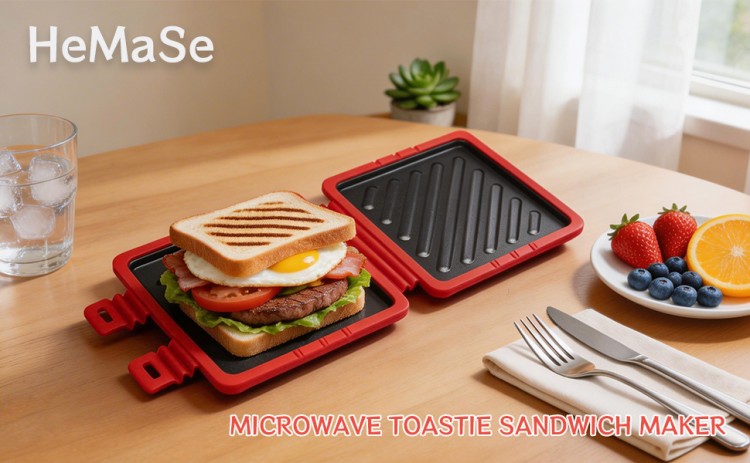
What does flat or ridged mean on a microwave grill plate?
The comparison concerns the face that touches the food. A flat microwave grill pan has a relatively smooth cooking face; a ridged pan has raised bands separated by lower channels. The outside shape can be round or square in either case. A flat underside beneath the pan is another feature entirely.
Also separate a microwave crisper plate from an ordinary serving plate. A smooth appearance does not establish a browning function or permission to use a metal pan in a microwave. The complete product must be intended for the selected appliance and operating mode. Our microwave grill pan guide explains the wider product family.
The heating system comes before the surface
A plate supplied for a dedicated appliance function is not automatically interchangeable with a standalone tray. For example, the Whirlpool MWC25 manual describes a Crisp function that combines Microwave and Grill cooking and requires its supplied plate. HeMaSe's Quick Cooking tray, by contrast, is for standard microwave use and excludes Grill/Convection modes.
Compare surfaces only after checking those instructions. A result from two different heating systems cannot be attributed to the ridges alone. If the appliance terminology is unclear, see a microwave grill pan versus a microwave with Grill Mode.
How do microwave grill pan ridges change browning?
Where food touches a heated plate, contact provides a route for heat to reach its surface. With a firm, flat underside resting across ridges, that contact is concentrated along the ridge tops. Between them, the food bridges the channels. A smooth face offers a more continuous contact area when the food can rest against it.
Food is not a rigid drawing. Bread can compress, a pizza base can curve, and a vegetable slice can bend. A smooth plate cannot make full contact with a bowed underside, while soft food may sink far enough to touch more than the tops of a ridged plate.
| Selection point | Smooth face | Ridged face |
|---|---|---|
| Contact with a flat, firm underside | Broader potential contact | Contact concentrated on raised bands |
| Intended appearance | A more continuous contact finish | Linear marks reflecting the surface pattern |
| Released liquid | Can remain between food and plate or move toward the edge | Can collect in channels below the contact bands |
| Small or soft pieces | A continuous support surface | May settle into channels or contact the ridges unevenly |
| Cleaning access | Fewer surface recesses, though edges still matter | Groove bottoms and ridge ends need attention |
| What the surface cannot establish | Heating capability, compatibility or a crisp result on its own | Heating capability, compatibility or a crisp result on its own |
Grill marks and overall browning are different goals
Grill marks on a microwave grill pan show where the pattern has left a visible finish. Strong lines with pale spaces between them may be exactly right for a panini-style product. They are less useful as the sole selling point for a product whose promise is an evenly browned pizza base.
Our view at HeMaSe is to judge the whole eating surface. Look at the spaces between the lines, the edges and the opposite face. Color, crispness and internal doneness are separate observations. A darker stripe cannot answer all of those questions.
Ridge height alone is a poor buying shortcut. Wider ridge tops change the available contact bands; wider channels change what the food must span. Neither detail tells you the plate temperature or the final texture. For the engineering choices behind the profile, use our microwave grill pan design guide.
Which surface makes sense for the food you actually sell or cook?
Start with one main food rather than an all-purpose claim. A retailer building a sandwich range needs a different product story from a brand focused on reheating pizza. A grill pan for microwave cooking should suit the food's footprint and loaded thickness as well as its desired appearance.
| Main use | What to prioritize | Surface choice to consider | Check before choosing |
|---|---|---|---|
| Toasties and filled sandwiches | Contact on both bread faces and normal closure around the filling | A ridged clamshell when a marked finish is part of the product; a smooth face when broader contact is the goal | Can the assembled sandwich fit without forcing the closure? |
| Pizza-slice reheating | Support and contact beneath the crust | A smooth contact face for a flat base; a ridged face if its contact pattern suits the intended finish | Does the slice sit on the active face, or does a curved crust hold the center clear? |
| Firm vegetable slices | Stable positioning and enough contact for the desired marks | Ridges where the pieces can span them; smooth support where pieces are smaller | Will the pieces rest across the pattern or settle into the channels? |
| Soft or irregular leftovers | Support, containment and release | A suitable smooth or deeper format rather than choosing solely for grill stripes | Is that food and loading method allowed by the specific product instructions? |
For sandwiches, filling distribution matters as much as the pattern
A mound of filling in the middle can hold the upper face away from the bread near the edges. Selecting deeper ridges will not correct that shape. Keep the food within the model's loading limits and distribute suitable fillings so the tray can close normally. Do not force buckles or add weights to make the food meet the plate.
For a brand, the bread format belongs in the product description. Square toast, a long roll and an oversized sandwich are different loads. Use the microwave grill pan size guide to separate the outside footprint from usable food space.
For pizza, look beneath the crust
A slice can fit inside a pan yet touch only around its outer crust. A flatter face is useful only where the base can sit against it. Before choosing by a pizza photograph, look at the product's food zone and whether a lid or upper plate would press into the toppings. A sandwich-style clamshell is not automatically the right format for every pizza slice.
Keep the promise specific: reheating an already cooked slice is different from cooking raw dough. Choose a product whose instructions cover the intended use. The broader relationship between contact and texture is explained in how to make food crispy in a microwave.
Do grooves remove moisture or just move it?
Grooves provide space below the raised contact bands. Liquid can move into that space, but a channel is not necessarily an outlet. In a closed tray, water may remain inside the assembly. A ridged cooking face should not be described as removing all moisture simply because the plate has visible grooves.
Excess moisture can also limit browning on a smooth face. GE's browning-dish guidance identifies excess moisture and food contact as relevant to browning. That general principle does not make its preheating, placement or cover instructions suitable for every tray.
For a filled sandwich, consider what the filling releases during heating, not just whether the bread feels dry before it goes in. Wet sauces and juicy ingredients change the conditions around the contact face. Increasing ridge depth does not substitute for a suitable recipe and the correct load.
Choose a pattern you can keep clean
With a ridged plate, inspect the groove bottoms, short ends of the ridges and the transition into the surrounding edge. Those are different cleaning surfaces from the broad top of a smooth plate. A soft sponge must reach them without requiring a sharp tool.
Follow the care instructions for the complete assembly, including removable parts. For the Quick Cooking tray, our published care method uses warm water and a soft sponge; it also warns against abrasive or sharp tools and rinsing a hot tray with cold water. Our microwave grill pan cleaning guide gives the fuller care sequence.
How do HeMaSe's tray formats fit this choice?
Our Microwave Toaster Grill Tray range includes different food-contact patterns and formats. The two products below are ridged examples. Their usefulness comes from the surface together with the way the food is held, not from treating ridges as a universal advantage.
Quick Cooking tray: a defined toast format with perimeter closure
The Quick Cooking Microwave Toaster Grill Tray combines a wavy plate with a silicone shell and four perimeter buckles. Its listed toast reference is approximately 12 × 12 cm. That is a bread-size reference, not an outside dimension or a guarantee that any filling thickness will fit.
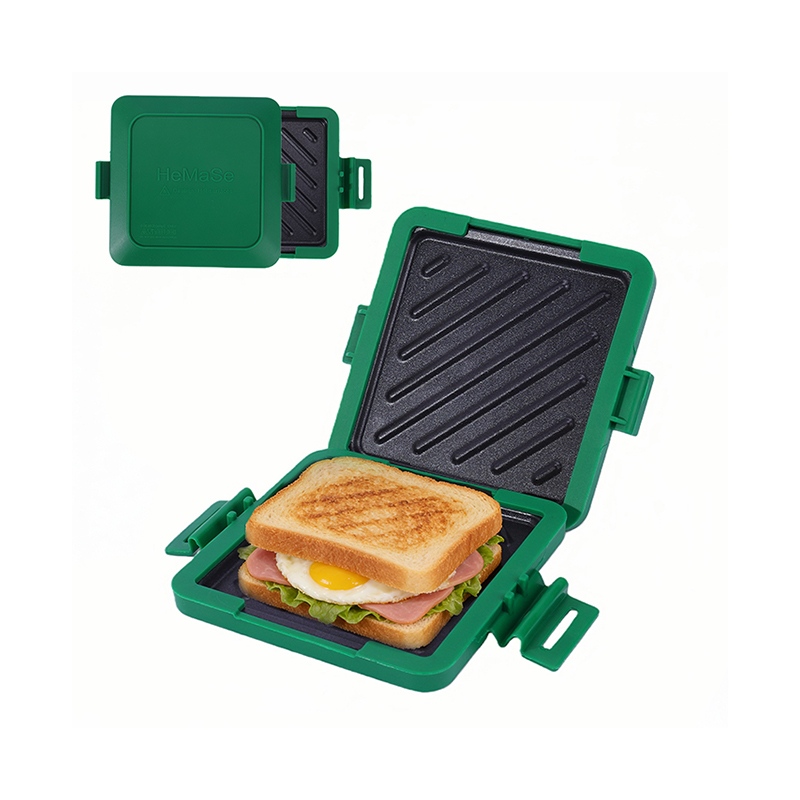
For this model, place food in the tray before heating and use the permitted microwave method. Do not borrow an empty-preheat routine or an appliance Grill setting from a different crisper plate.
3-in-1 tray: corrugated faces with a detachable structure
The 3-in-1 Microwave Toaster Grill Tray pairs corrugated cooking faces with a silicone shell and a detachable construction. The plate and shell can separate for cleaning. This is useful to consider when access around the plate matters as much as the visible sandwich pattern.
We would choose between formats by the main bread shape, normal loaded closure and preferred cleaning access. For an importer or retail brand, those are clearer product differences than promising that every meal will be crispier because the face has deeper grooves.
How should you choose without being misled by a product photo?
- Define the main result: visible grill lines, broader surface browning, or support for a particular food shape.
- Confirm the exact product and permitted appliance mode. A smooth ordinary pan is not a microwave crisper plate simply because it looks similar.
- Look at the food-contact face and the actual load together. Check the food zone, underside shape and normal closure where applicable.
- Check how the lower channels and edges can be cleaned with the permitted tools.
- Write the product promise around that food and method, rather than transferring claims from another plate.
From our factory perspective, a sandwich-led range has a good reason to choose a visible pattern: the mark is part of the product's intended finish. A range focused on broader base contact has a different priority. We would settle that decision before choosing colors or packaging imagery.
For example, if your main product is a filled toastie, show the bread size and the filled tray, not only the empty cooking plate. If it is a pizza-reheating accessory, show how the slice rests on the face. These views help the buyer understand what the geometry actually supports.
A clear product description can say which food the tray is designed around and which appearance the pattern is intended to create. It should not treat a photograph of dark grill marks as proof of all-over crispness. For the loading and handling steps after selection, follow how to use a microwave grill pan.
Frequently asked questions
Is a microwave crisper plate always flat?
No. The name describes an intended function, not a fixed surface geometry. Check the food-contact face, the complete product construction and the appliance instructions. A plain turntable or serving plate is not automatically a browning accessory.
Do deeper ridges make food crispier?
Not automatically. Ridge depth changes the space beneath food and its contact with the plate. Food shape, moisture and the permitted heating method still affect the result. Choose the profile for your main food rather than treating depth as a performance rating.
Can I use the same cooking settings when switching from a ridged pan to a flat plate?
Do not assume so. Different plates can have different heating systems, loading instructions and permitted modes. Use the directions for the replacement product and your appliance, even when their sizes look similar.
Choose a HeMaSe tray around your main food
Explore HeMaSe's microwave toaster grill trays, including the Quick Cooking and detachable 3-in-1 formats. Tell us your main bread or food shape and the finish you want so we can discuss a relevant model for your range.
Explore HeMaSe Grill TraysDiscuss Your Product Format