

Two microwave grill pans can use similar materials and behave like different products. The difference often comes from geometry: how much of the food touches the active plate, where moisture can move, how the two halves close and whether the shape fits both the microwave cavity and the retail use case. For a brand, those decisions should be settled before color and packaging take over the project.
A useful microwave grill pan design starts with one defined food load and one clear customer promise. Choose the active cooking area, surface profile, closure, moisture path and overall form around that load. Then validate the assembled design in the intended microwave mode. A deeper ridge or tighter buckle is not automatically an improvement. Each change alters contact, cleaning, fill height or steam behavior.
What should the design brief define before the first drawing?
Start with the food. That sounds obvious, but many briefs begin with an outside dimension, a color and a reference photo. Those inputs describe how the product should look. They do not tell the factory what the cooking faces must do.
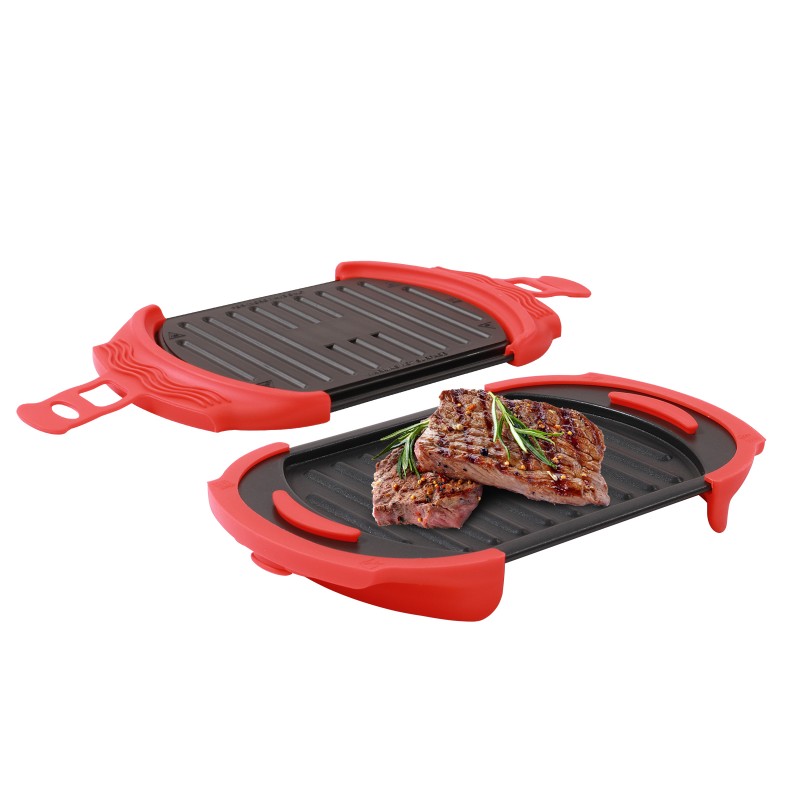
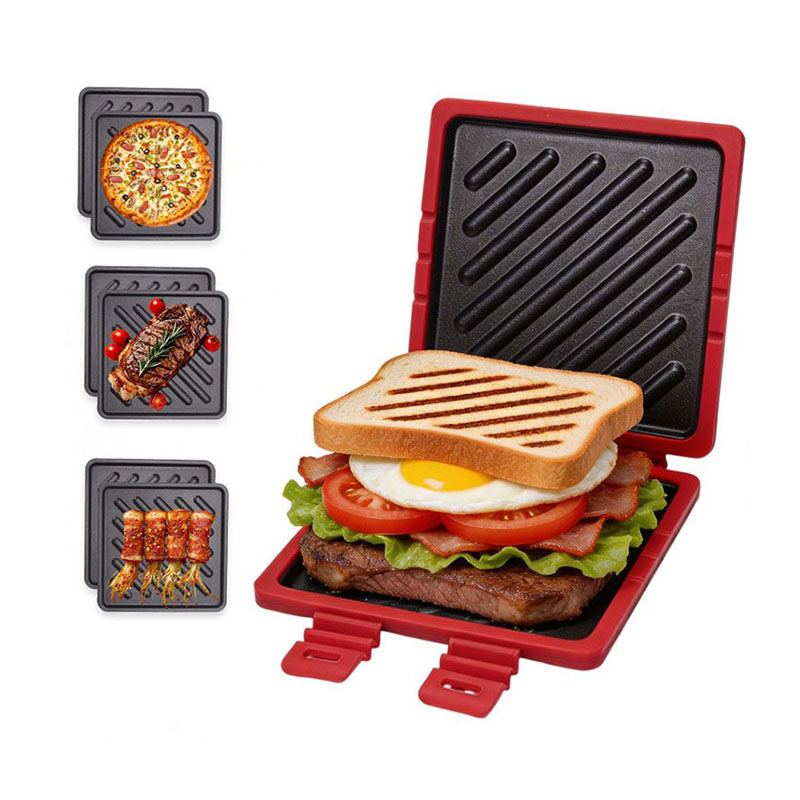
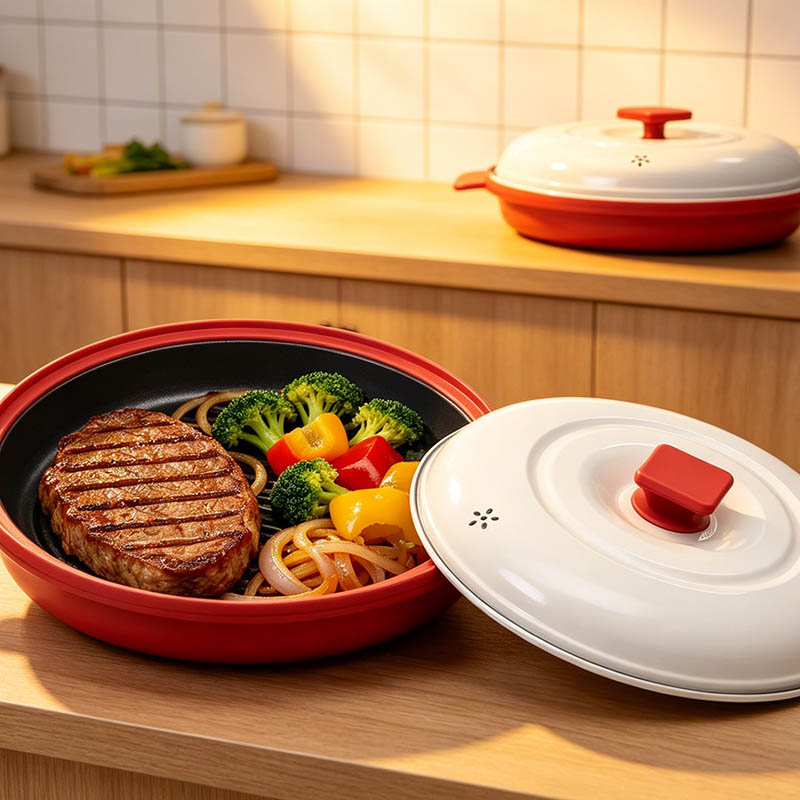
A sandwich press needs to accept bread, fillings and a changing total thickness. A waffle-pattern tray needs enough contact to form the intended surface while still releasing the food. A lidded grill pot has to manage a deeper load, released liquid and steam. The shape follows a different problem in each case.
The brief should name the representative food, portion size, starting condition, target surface result, microwave mode, expected handling and cleaning method. If several foods are planned, rank them. One primary load provides a stable basis for the plate profile and closure. Secondary uses can be checked later without making the initial design vague.
The six decisions behind a microwave grill pan design
Active area
The plate area that can make useful contact with the intended food, excluding edges, hinges and closure zones.
Surface profile
Flat, linear ridge, cross-hatch, waffle or embossed geometry and the transition into the surrounding plate.
Food clearance
The space between opposing faces or beneath a lid when the representative load is in place.
Closure
Buckle, hinge, weighted lid or open format, plus the way that closure controls position and pressure.
Moisture path
Grooves, low points, gaps and vents that affect where oil, water and steam collect or escape.
Handling envelope
Overall footprint, turntable clearance, grip points, opening motion, storage and access for cleaning.
These decisions interact. Increasing food clearance may weaken contact on a thin sandwich. Enlarging the plate may reduce the silicone grip area or create turntable-clearance problems. A more detailed embossing may support a strong retail story but add corners that need closer cleaning review.
This is why design approval should cover the assembled pan rather than a set of attractive component renderings. The general microwave grill pan guide explains how the category creates a hot contact surface. The design task is to make that surface meet the selected food in a repeatable way.
Which cooking-surface pattern fits the food?
Surface patterns have three jobs: create or limit contact, give released moisture somewhere to move and produce a visible food finish. The retail team may care most about the mark. The product team must also account for food release and the brush or sponge that has to reach the low points.
| Surface profile | Contact behavior | Possible product fit | Question before approval |
|---|---|---|---|
| Broad or shallow wave | Alternates raised contact bands with open channels | Toast, sandwiches and foods where linear marks suit the product story | Does the representative food bridge across the grooves or sag into them? |
| Cross-hatch or waffle grid | Divides the face into smaller cells and contact points | Pattern-led breakfast products and pressed snacks | Can sticky residue be removed from the corners without abrasive tools? |
| Character embossing | Uses local raised and recessed features to create an image | Licensed, gift or family-oriented ranges | Does the image remain legible across the actual food thickness and recipe? |
| Corrugated pot base | Raises parts of the load while channels collect released liquid | Deeper cookware intended for larger or irregular pieces | Will the selected load sit in one layer with useful base contact? |
| Flatter contact face | Maximizes contact area when the food surface is also flat | Products where uniform face contact matters more than a strong mark | Where will moisture go when the food releases water? |
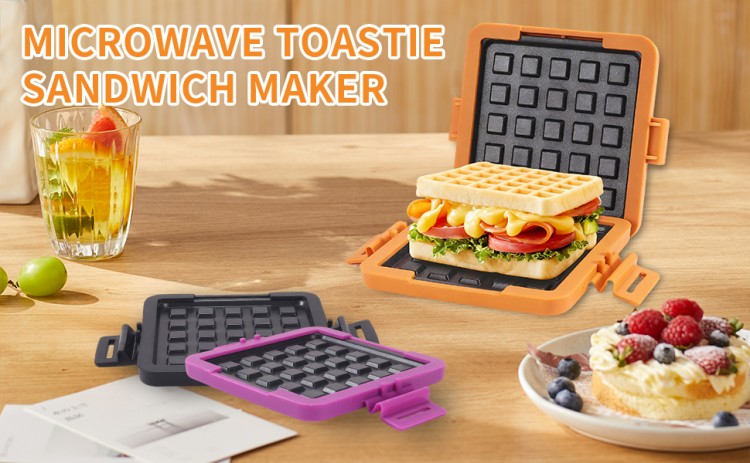
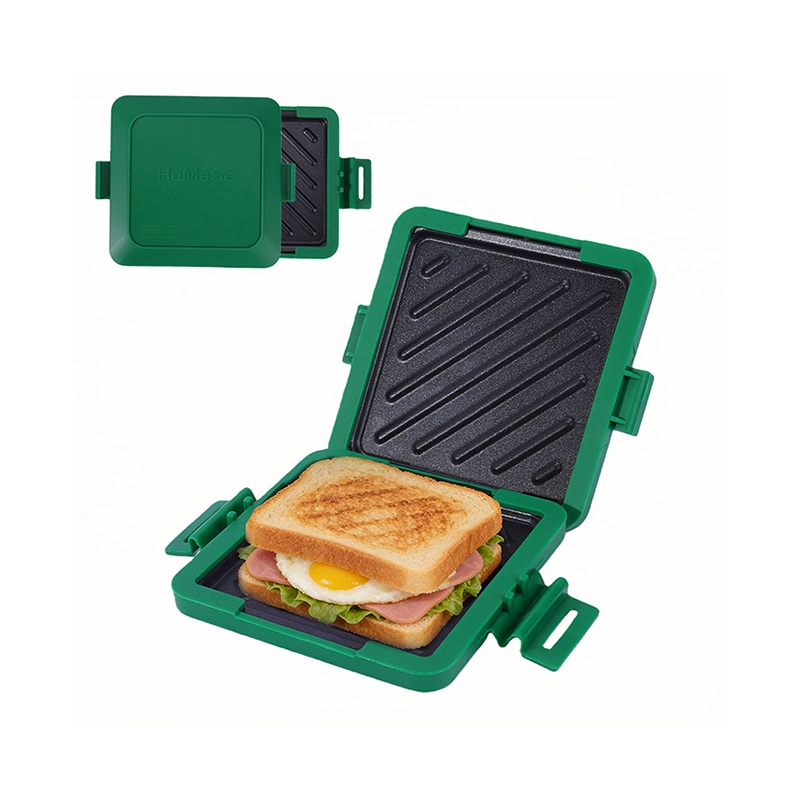
HeMaSe currently shows several distinct surface concepts. The Square Microwave Toaster Grill Tray page identifies a wave-pattern cooking face. The Waffles Microwave Toaster Grill Tray uses a grid, while the Round Microwave Toaster Grill Tray presents a character embossing. These are company descriptions of the available formats. They are not proof that one pattern will work for every recipe.
Usable cooking area matters more than outside size
Outside dimensions tell you whether the pan may fit an appliance or package. They do not tell you how much food can sit on the active face. A border may contain the coating edge, support the silicone frame, create a hinge or hold a buckle. That border is part of the product, but it should not be counted as usable cooking area.
Ask the drawing to identify three outlines: the total product footprint, the metal or active-plate boundary and the recommended food zone. Then place the primary load inside all three. A sandwich that fits the outside frame but overlaps the heated area can give a misleading impression of capacity.
The same exercise should be repeated in the microwave cavity. Check the closed product on the turntable, then check the hand movement required to insert, remove and open it. A handle that clears the oven wall while stationary may still catch when the turntable rotates. Exact clearances belong in the project drawing and test record rather than in a general article.
How should a clamshell microwave grill pan close?
A closure keeps two halves aligned and controls how they meet the food. More pressure is not always better. A thin slice may need close face contact, while a filled sandwich needs enough travel to avoid pushing the contents out. The useful question is whether the closure accommodates the defined load without twisting the plates or leaving one corner open.
The current Quick Cooking Microwave Toaster Grill Tray page describes four symmetrical buckles around the product. That arrangement gives a brand four inspection points. Sample review should check whether each buckle closes, whether the plates remain aligned and whether release is manageable after the approved heating and cooling sequence.
Do the check with food in place. An empty closure test can confirm basic assembly, but it cannot show how the pan behaves around a real load. Record bread thickness, filling distribution and final closed position so the factory and buyer are evaluating the same thing.
Where will steam, oil and released water go?
Crisping and moisture control are tied together, yet a product brief often treats drainage grooves as a decorative detail. Map where liquid can move when the product is level, where it collects and whether it can reach the coating edge, hinge or silicone interface.
A clamshell press and a lidded pot need different answers. The press has a shallow gap and two opposing surfaces. Escaping steam may soften the food if the cavity is crowded, while a groove can provide local space away from the contact bands. A pot has more headroom and can use a lid or vent to manage steam, but the deeper volume may retain more moisture around the load.
Research on microwave susceptors supports a cautious development approach. In one controlled study using dough and commercial susceptor films, the researchers found that moisture content, product dimensions and initial temperature affected the measured heating result. The equipment and susceptor were different from reusable HeMaSe cookware, so the reported temperatures do not transfer to these products. The useful lesson is narrower: geometry and the food load must be recorded together.
Tray, clamshell press or lidded multi-pot?
Simple loading and direct access. The top surface remains open, so the design has less control over upper-face contact and splatter.
Two cooking faces and a closure can press the load. Fill-height range and plate alignment become central design decisions.
A deeper body accepts thicker or irregular loads. Lid behavior, headspace, steam path and base contact need to work together.
Different plates can extend the range. Fit, orientation, part identification and cleaning of separated pieces add complexity.
A 3-in-1 idea sounds efficient in a sales meeting, but every extra plate creates another mating surface and another item to identify in the box. The current HeMaSe 3-in-1 Microwave Toaster Grill Tray page describes a detachable structure. A private-label version should specify which pieces belong to the approved configuration, how they are oriented and whether the consumer can assemble them incorrectly.
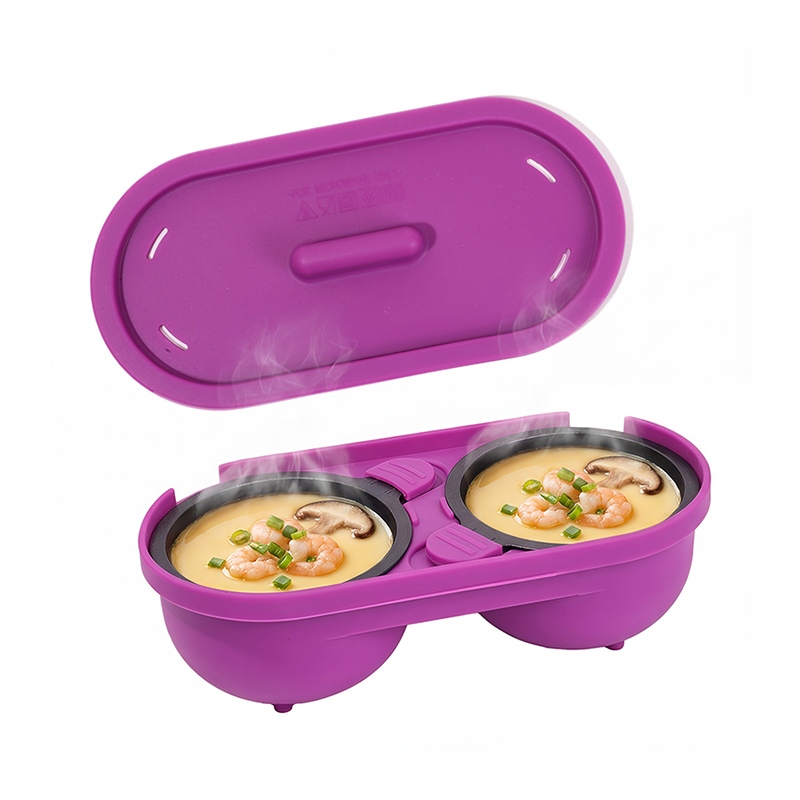
The lidded format solves a different product job. HeMaSe's Food Grade Microwave Multi Cook Grill Pot page describes a weighted lid and a side pressure-relief feature instead of clamshell buckles. The development review should therefore focus on lid seating, the steam path, base contact and access to the pot interior.
Designing the pan for cleaning and inspection
A pattern is only successful if the owner can clean it with the tools permitted by the instructions. Look at the lowest groove, the transition between plate and silicone, the area beneath a removable part and any recess around a buckle. If the product requires a sharp pick or abrasive pad to remove normal residue, the cleanability problem is already built into the geometry.
The inspection team needs the same access. It should be possible to see coating edges, trapped residue, movement between materials and closure damage without destroying the sample. A removable construction can improve access, but it also needs positive orientation and a reliable reassembly check.
From a factory perspective, "easy to clean" is too vague for a drawing review. The project should state the intended cleaning method, detergent or tool restrictions, whether parts separate and which conditions cause the consumer to stop using the pan. The microwave grill pan materials guide explains how the cooking face, substrate, responsive layer and silicone structure should be documented as one system.
Which custom changes are low risk, and which reopen the design?
Customization is not one category. Some changes leave the cooking geometry intact. Others alter the way the pan closes, heats, drains or fits an appliance. The quotation and schedule should separate them early.
| Requested change | Likely design impact | What needs review |
|---|---|---|
| Outer packaging artwork | Usually does not change the pan geometry | Claims, instructions, product identity and pack-out |
| Logo on a defined non-contact area | May be limited if process and placement are already supported | Decoration method, location, durability and compliance basis |
| Silicone color change | Geometry may stay fixed, but the material evidence can change | Pigment system, approved reference, odor and appearance controls |
| New plate pattern | Changes food contact, release, cleaning and visual result | Tooling, coating coverage, active area and recipe trial |
| Deeper food cavity | Changes closure position, contact and product envelope | Load range, plate alignment, microwave clearance and handling |
| Different buckle or lid | Changes the assembled behavior | Fit, opening force, alignment, steam path and misuse risks |
| Larger outside dimensions | May change turntable fit and active-zone relationship | Cavity clearance, rotation, grip access, plate flatness and packaging |
A useful rule is simple: if the change touches the food, moves the active plate, alters the closure or changes the appliance envelope, treat it as a product change. It needs more than a new rendering.
How should a prototype be evaluated?
One photo of a browned sandwich is not a development record. It does not identify the microwave, food dimensions, starting condition, orientation, sequence or the condition of the pan afterward. The prototype review should make the result repeatable enough for both parties to discuss the same behavior.
Research on a rotating frozen meal found that layer thickness, order, material properties and package shape affected microwave heating. That work used lasagna in a specific domestic oven, not a reusable grill pan, and its numerical results should not be applied to HeMaSe products. It does show why a product developer must record the food structure and package geometry as part of the test.
Prototype review record
- Prototype code, drawing revision and material revision are identified.
- Microwave model, selected mode and turntable position are recorded.
- Food type, mass, dimensions, starting condition and orientation are recorded.
- Active-area coverage and final closure position are photographed.
- Both food faces are reviewed for contact pattern, color and released moisture.
- The plate, coating edge, silicone, hinge, buckle or lid are inspected after use and cleaning.
- Any adjustment changes one defined variable at a time where practical.
For a food-safety-sensitive application, the brand also needs an appropriate temperature and safety protocol. Browning is a surface observation. It cannot prove that the coldest part of a food reached a safe internal temperature.
What the current HeMaSe range shows about design choice
The HeMaSe Microwave Toaster Grill Tray category contains square, round, waffle-pattern and multi-format products. That variety makes one point clear: "microwave grill pan" is a product family, not one fixed shape.
For a mainstream sandwich program, a square clamshell puts usable area and four-point closure at the center of the brief. For a breakfast product built around a visible mark, the waffle or character surface becomes part of the brand promise. For thicker and irregular loads, a multi-pot offers depth and a lid, but its development questions shift toward headspace, base contact and steam behavior.
The design should be chosen in that order: customer job, food load, geometry, validation and then visual customization. Starting with a logo and forcing the rest to fit usually creates a product that photographs well but has no clear primary use.
Frequently asked questions
What is the best shape for a microwave grill pan?
There is no universal best shape. A square clamshell often suits bread and sandwiches, a patterned round plate can support a visual breakfast concept, and a lidded pot suits deeper or irregular loads. Choose the shape after defining the primary food, active area, closure and microwave-cavity fit.
Do deeper grill ridges make food crispier?
Not automatically. Ridge depth changes contact area, the space available for released moisture and the ease of cleaning. A deeper pattern can produce a stronger mark on one food while reducing contact on another. Evaluate the profile with the representative load.
Why does active cooking area differ from the outside dimensions?
The outer footprint includes the frame, silicone edge, hinge, handles and closure zones. Only part of that footprint may be an active heated cooking face. Draw and measure the recommended food zone separately before making a capacity claim.
Is a clamshell microwave grill pan better than an open tray?
A clamshell adds a second contact face and can hold a sandwich in position, but it also needs clearance, alignment and a controlled closure. An open tray is simpler to load and inspect. The better format depends on the food and the result the brand intends to sell.
Can a brand customize the grill pattern?
A pattern can be customized when the product and tooling route support it, but it is a functional change. Review food contact, release, cleaning, coating coverage, active area, tooling and the result on the intended food before approval.
What should a brand send for microwave grill pan development?
Send the destination market, representative foods, load dimensions, microwave mode, preferred form, active-area requirement, surface pattern, closure, cleaning method, branding and compliance-document expectations. A reference photo helps, but it cannot replace those inputs.
HeMaSe product development
Turn the product idea into a design brief
Send HeMaSe the target food, load size, microwave mode, preferred tray or pot format, surface pattern, closure, brand treatment and destination-market requirements. Our team can use that information to review an existing format or define the open points for a modified design.
Discuss a Microwave Grill Pan Design