

A microwave grill pan needs two kinds of fit. It must fit the oven without touching the cavity, and it must fit the food in a useful layer. For an importer or private-label brand, overall length and width are only the start. Handles, corner diagonal, lid height, active cooking area, closure travel and the packed product all belong in the size specification.
Specify a microwave grill pan with three linked envelopes: the oven-fit envelope, the food-load envelope and the retail-pack envelope. Measure the full exterior, including handles, buckles, lid knob and any part that moves during closure. For a rectangular pan on a rotating turntable, check its corner-to-corner span as well as its width and depth. Then record the usable cooking surface and permitted food thickness separately. A model is not properly sized until a physical sample rotates freely, closes around the intended food and fits the approved packaging.
A microwave grill pan has three size envelopes
Size discussions become muddled when one measurement is asked to do every job. At HeMaSe, we recommend separating the specification into three envelopes. Each answers a different buyer question.
Oven-fit envelope
The maximum outside shape in use, including handles, lid knob, buckles and the full rotation sweep. This decides appliance compatibility.
Food-load envelope
The usable plate or cavity, safe fill line and permitted closed height. This decides which portions and food formats the product can support.
Retail-pack envelope
The product in its shipping configuration, with inserts, instructions and protective space. This decides shelf fit, carton design and logistics planning.
A pan can pass one envelope and fail another. A wide silicone handle may make the product easy to lift but stop a small turntable from rotating. A compact clamshell may fit the oven yet accept only a thin food load. A detachable design may use the cavity well but need more protective packaging because its parts can rub in transit.
Which microwave grill pan dimensions belong on the drawing?
The drawing should distinguish the outside product from the cooking zone. Do not label both as simply "size." The following fields cover most toaster trays, clamshell grill pans and lidded multi-pots.
| Measurement | Where to measure | Why the buyer needs it | Common omission |
|---|---|---|---|
| Overall width | Extreme outside edge to edge, including fixed handles or tabs | Checks cavity and door clearance | Only the metal plate is measured |
| Overall depth | Frontmost to rearmost point in the normal operating position | Checks cavity depth and rotation | A buckle or handle is excluded |
| Maximum diagonal | Across the outer bounding shape of a square or rectangular product | Estimates the diameter needed for turntable rotation | Only width is compared with turntable diameter |
| Overall height | Base to the highest point, including lid knob or closed top shell | Checks cavity height and package depth | The lid is measured separately but not as an assembly |
| Usable cooking width and depth | Food-contact area inside the rim or seal | Defines the portion that receives plate contact | The outside size is presented as cooking area |
| Closed food clearance | Minimum internal gap at the approved closed position | Defines sandwich or food thickness without forcing the latch | Empty closure is checked, but loaded closure is not |
| Fill capacity or working depth | Usable volume or depth below the approved fill limit | Controls liquid, steam and spill risk for multi-pots | Brimful capacity is used as working capacity |
| Pack dimensions | Finished retail unit with insert and manual | Supports shelf, master-carton and fulfillment planning | A bare product estimate is used before packaging is designed |
Measurement diagram created for this guide. It is schematic and contains no model-specific dimensions.
How do you check turntable and cavity fit?
A rotating microwave does not care only about the product's narrow side. A rectangular pan sweeps its corners through a circle. Handles and buckles join that sweep, so a tray that sits on the glass plate when stationary may still strike a wall or door frame as it turns.
For a simple rectangular outer shape, the corner-to-corner span is:
This calculation is a screening tool, not the final approval. Tabs may be asymmetric, the turntable coupler may not center the load perfectly, and the door or rear wall can reduce usable space. Make a full rotation check with the assembled sample in the intended appliance group.
GE Appliances' current dish-clearance guidance tells users to measure the full pan, include handles and consider the diagonal of a square or rectangular dish. It recommends clearance from the oven walls and door so the turntable can rotate. Use the microwave manufacturer's manual as the controlling instruction for each appliance model.
What if the microwave has no turntable?
A flatbed oven removes the rotating-circle constraint, but it does not remove fit checks. Confirm the clear cavity width, depth and height, the door path, the manufacturer's cookware instructions and any required spacing. Do not market one compatibility claim across turntable and flatbed ovens until both groups have been reviewed.
Overall size is not usable cooking area
A food image can make a pan look generous because the shell, handles and rim enlarge the silhouette. The working area is the coated surface that the food can actually contact without crossing a seal, groove boundary or closure zone.
Measure and publish the usable zone separately:
- flat contact length and width for bread, pizza slices or thin proteins;
- ridge-to-ridge area when only the raised profile contacts the food;
- internal base area and working depth for a multi-pot;
- food clearance after the upper plate or lid is in its approved position;
- any zone that must remain empty for a latch, vent, seal or drainage channel.
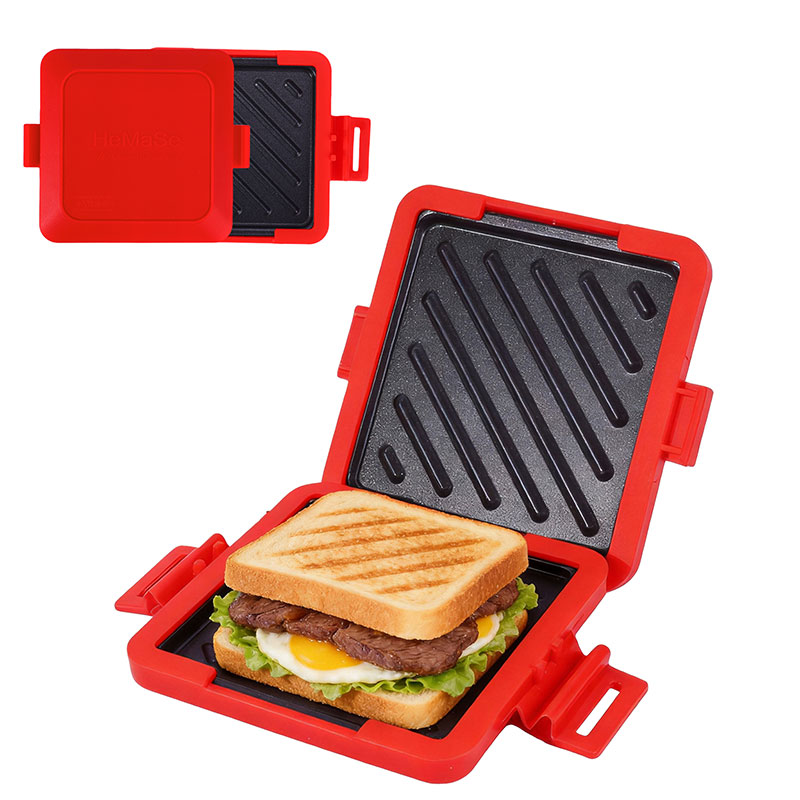
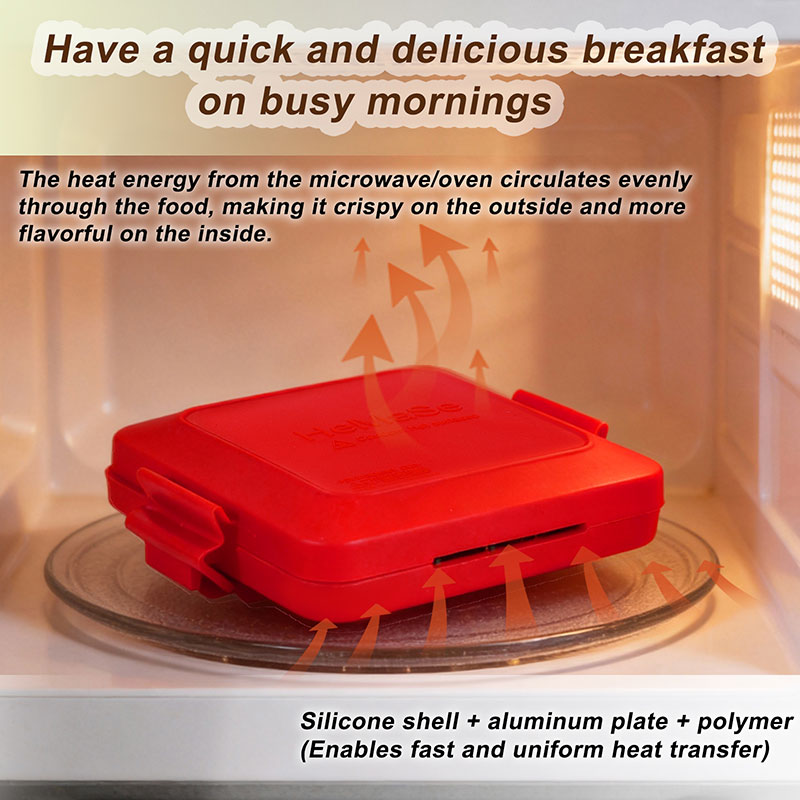
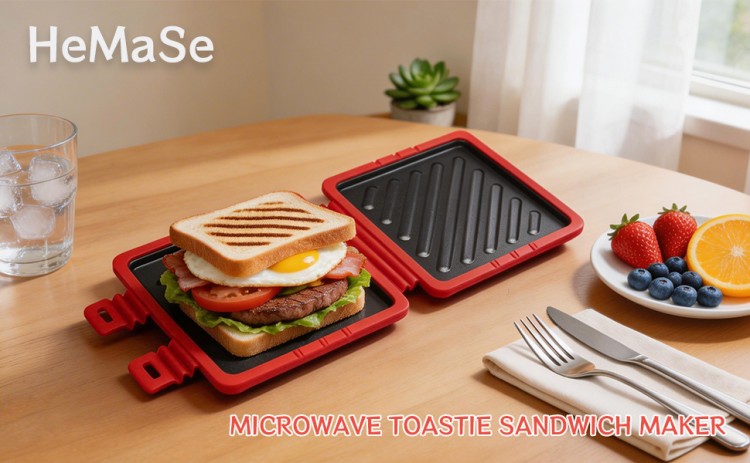
The distinction appears in HeMaSe's current catalog. The Quick Cooking Microwave Toaster Grill Tray page describes a four-buckle format and lists an approximate 12 x 12 cm square toast size. That is a food-fit reference, not the product's overall outside dimension. A buyer still needs the complete assembly drawing and a physical oven-fit check.
Food height, lid height and closure travel need separate limits
Height is straightforward for an open tray and more complicated for a clamshell or lidded pot. A clamshell has an empty closed height, a permitted food-load height and a latch position. A multi-pot has body depth, working fill depth, lid clearance and a highest external point such as a knob.
Do not solve an overfilled clamshell by asking the user to force the closure. That changes plate contact, loads the hinge or buckle and can move fillings into the seal area. A sample plan should use the intended bread, filling pattern and total food thickness. If the product needs two closure positions, both positions belong on the drawing and in the instructions.
For a lid, confirm:
- assembled height at the highest point;
- clearance above the knob and around side handles;
- working fill limit rather than brimful volume;
- vent and seal position with the approved food load;
- whether the lid nests, inverts or packs separately for retail.
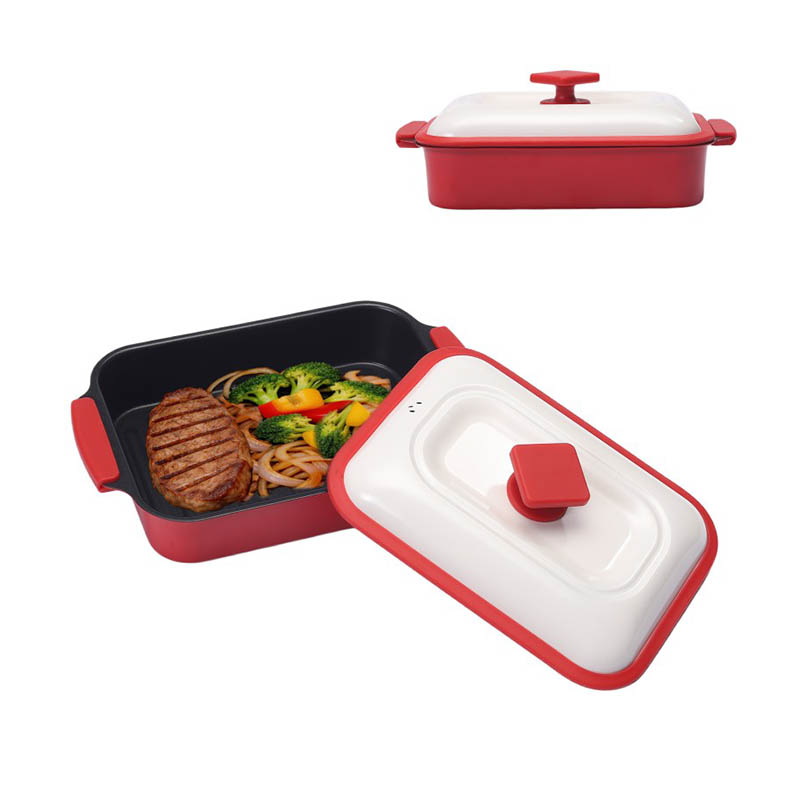
The current HeMaSe large-capacity lidded grill pan page lists an overall size of 25.3 x 16.1 x 8.7 cm and a capacity of 1000 ml. Those are useful catalog references, but they are not interchangeable. The outside dimensions describe fit; the stated capacity describes internal volume. For sourcing, confirm both against the current controlled drawing and physical sample.
Round, square or rectangular: which shape uses space best?
No shape wins every project. The correct choice depends on the food format, oven population and retail promise.
| Shape or format | Space advantage | Watch point | Useful B2B position |
|---|---|---|---|
| Round pan or pot | The outer diameter maps directly to a circular turntable when handles stay inside that diameter | Protruding handles can become the true maximum diameter | General meal preparation, lidded formats and simple fit communication |
| Square clamshell | Matches square toast and uses the plate area efficiently for sandwiches | The diagonal can be much larger than the width | Breakfast, snack, gift and sandwich-focused retail |
| Rectangular tray or pot | Fits elongated foods and can create a wider serving format | Corner sweep and long handles may limit rotation in compact ovens | Meal portions, larger sandwiches and multi-use cookware ranges |
| Deep lidded body | Adds internal volume without expanding the base by the same proportion | Overall height, venting, fill level and packed lid become part of fit | One-pot meals, steaming, reheating and broader meal claims |
A square food target does not automatically require a square outside shell. Likewise, a round turntable does not forbid a rectangular product. The design task is to balance the useful food area against the rotation envelope and handling features.
HeMaSe currently separates the range into Microwave Toaster Grill Trays and Microwave Grill Multi-Pots. That split is more useful for size planning than treating every item as the same pan in a different outline.
What can buyers learn from HeMaSe's current product formats?
The catalog does not publish one universal microwave grill pan size, and it should not. The food task changes the architecture. The examples below show how the measurement priority moves with the format.
| Current HeMaSe example | Published feature relevant to size | What the buyer should confirm next |
|---|---|---|
| Quick Cooking Microwave Toaster Grill Tray | Four symmetrical buckles; approximate 12 x 12 cm square toast reference | Full outside footprint, diagonal, loaded closure height and buckle clearance |
| 3-in-1 Microwave Toaster Grill Tray | Detachable baking plate and silicone casing; snap-lock construction | Assembly fit, part nesting, usable area and pack configuration |
| Square Microwave Toaster Grill Tray | Square wave-pattern plate with integrated silicone handling and closure features | Outside diagonal, handle sweep, food-contact zone and closure position |
| Large-Capacity Grill Pan with Lid | Current page lists 25.3 x 16.1 x 8.7 cm overall and 1000 ml capacity | Current controlled drawing, working fill line, highest lid point and target-appliance fit |
| Round Glass-Cover Microwave Grill Multi-Pot | Round deep body, side handles and glass lid | Maximum handle diameter, assembled height, lid weight and retail-pack protection |
These are product-page references, not substitutes for project records. A live page can change, and a family name can cover more than one version. Put the selected model number, drawing revision and approved sample ID into the order file.
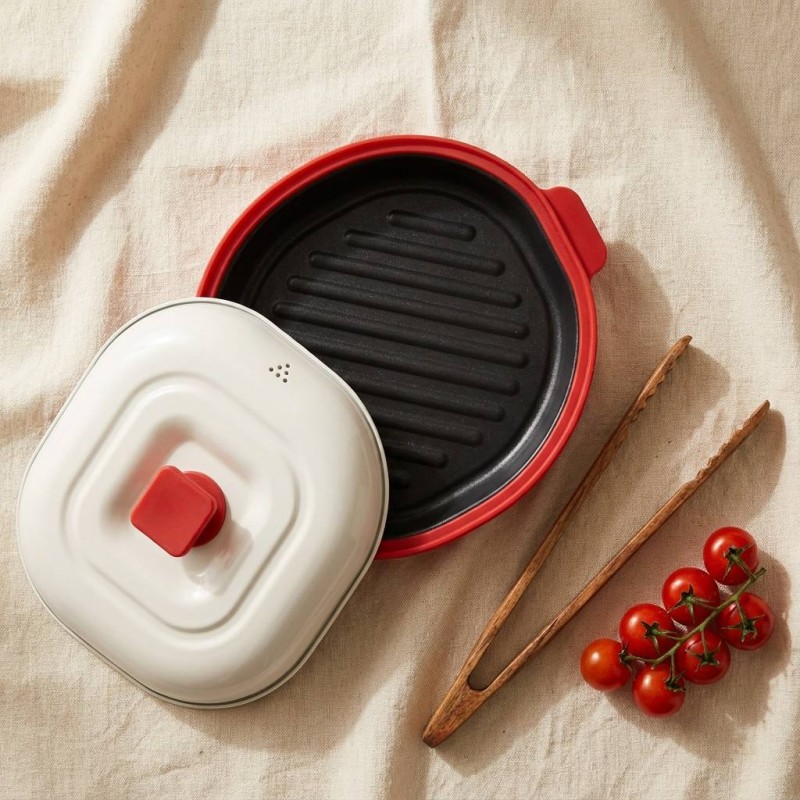
How should an importer plan a microwave grill pan size range?
More sizes do not automatically create a better range. Each extra footprint adds a new fit claim, package, instruction set, inventory line and sample burden. Start with the food and appliance groups that matter to the channel.
One size for one clear job
A sandwich-focused SKU can be sized around the chosen bread format and closure load. A lidded multi-pot can be sized around a meal portion and working fill limit. The product page, manual and photography should all show that same job. Broad claims such as "fits every microwave" or "cooks every meal" are difficult to defend and easy for customers to disprove.
A second size should solve a different constraint
A compact version may target a smaller oven group or smaller food portion. A larger version may trade broad appliance fit for more cooking area. Write that trade-off into the product brief before changing the mold. If the two sizes promise the same food, the same portion and the same appliance coverage, the range may only be duplicating inventory.
Keep the naming tied to measurements
Words such as mini, standard and large are relative. Pair the commercial name with outside dimensions, usable area or working capacity. Keep the same measurement order on the product page, color box, manual and distributor sheet so buyers do not have to guess whether a sequence means length x width x height or something else.
The broad microwave grill pan guide explains the category and its main formats. The present page owns the narrower sizing decision and should receive internal links wherever the site discusses product fit, turntables, capacity or size options.
How do you approve a size sample before mass production?
A caliper report is useful, but it cannot show whether a customer can close the pan around the intended sandwich or remove a hot lid without hitting the cavity. Size approval needs both measurement and use simulation.
Sample-size approval checklist
- Identify the sample, drawing revision and product configuration.
- Measure overall width, depth and height at their true outside extremes.
- Record the diagonal or maximum rotation diameter, including handles and tabs.
- Measure the usable plate area, internal depth and any keep-clear zones.
- Load the approved food portion and check closure, latch engagement and seal position.
- Place the assembly in representative target microwaves and observe a full rotation.
- Check insertion and removal through the door, including a safe grip path.
- Confirm the lid, detachable parts and manual fit the proposed retail insert.
- Repeat the measurements after the agreed functional test sequence.
- Photograph the approved measurement points and link them to the sample record.
The microwave grill pan use guide covers operating checks, while the microwave sandwich maker guide explains the clamshell format. Size approval should borrow the relevant use case rather than testing an empty product only.
Compliance documentation also needs the exact construction. The U.S. FDA explains that the overall regulatory status of a food-contact material depends on the regulatory status of its individual substances and their intended conditions of use. A size or geometry change can alter food-contact area, food type, time or temperature assumptions, so the buyer should ask the responsible compliance specialist whether the existing evidence still applies.
What size data should go into an OEM RFQ?
A useful RFQ lets the factory test a real design problem. Send evidence of the appliance, food and package constraints rather than choosing an outside size from a competitor listing.
| RFQ field | Information to provide | What it controls |
|---|---|---|
| Target market | Countries, sales channel and intended appliance group | Instructions, evidence and compatibility sampling |
| Microwave fit | Turntable diameter or flatbed cavity dimensions, door opening and relevant manuals | Maximum outside and rotation envelope |
| Primary food | Food outline, portion count, loaded thickness and preparation state | Usable area, depth, closure and surface pattern |
| Product format | Open tray, clamshell, detachable set, deep pot or lidded body | Assembly height, handles, vents and moving parts |
| Retail promise | Specific foods and functions that the package will claim | Sample method and instruction scope |
| Package limits | Maximum shelf footprint, fulfillment rule or master-carton constraint | Nesting, lid position, inserts and box size |
| Reference sample | Existing HeMaSe model, buyer sample or drawing | Whether the project begins from a current platform or new tooling |
Our preferred starting question is simple: what must fit inside what? The food must fit the active area. The assembled product must fit the intended microwave. The protected product must fit the retail and transport pack. Once those relationships are clear, color, logo and surface styling can be reviewed without hiding the basic geometry.
Frequently asked questions
What is the best microwave grill pan size?
There is no universal best size. The pan must fit the target microwave with operating clearance and fit the intended food on its usable cooking surface. Define the oven-fit envelope, food-load envelope and retail-pack envelope, then approve them with a physical sample.
Should a microwave grill pan be smaller than the turntable?
Its full rotation sweep must remain clear. For a round pan, check the maximum outside diameter including handles. For a square or rectangular pan, check the corner-to-corner span and any projecting tabs. Follow the appliance manufacturer's clearance instructions and confirm a full rotation with the assembled sample.
How do you calculate the diagonal of a rectangular grill pan?
For a simple rectangle, calculate the diagonal as the square root of overall width squared plus overall depth squared. Use the maximum outside measurements, including fixed projections. Because real products may have asymmetric handles or tabs, finish with a physical rotation-sweep check.
Does microwave capacity in liters tell me which pan will fit?
No. Nominal oven capacity describes cavity volume, not the clear width, depth, height or turntable sweep available to the cookware. Request the appliance's internal dimensions, turntable diameter and manual, then test the product in representative models.
Is pan capacity the same as usable cooking area?
No. Capacity describes internal volume, while usable cooking area describes the surface available for food contact. A lidded multi-pot may need both working capacity and base area. A clamshell tray needs usable plate dimensions and permitted closed food height.
What measurements should I send for a custom microwave grill pan?
Send target oven dimensions, turntable diameter, door opening, intended food size and thickness, product format, required outside limits, usable cooking area, lid or closure needs and packaging constraints. Include the target market and appliance manuals so the sample plan reflects the intended use.
Sources and scope
First-party product references were checked on the current HeMaSe Microwave Toaster Grill Tray, Microwave Grill Multi-Pot, Quick Cooking Tray and Large-Capacity Lidded Pan pages on September 16, 2026. The external technical references used are GE Appliances' current dish-clearance guidance and the U.S. FDA's current food-contact component guidance. Final specifications must come from the selected model's released drawing, sample and applicable market review.
HeMaSe | Ningbo Sai'an Intelligent Technology Co., Ltd.
Send us the fit problem, not just a target length
Share the target microwave cavity or turntable, food dimensions, portion, preferred format, package limits and destination market. HeMaSe can compare that brief with its current grill-tray and multi-pot formats, then discuss whether an existing model or a new size route is appropriate.
Contact HeMaSe about pan sizing