

1. What Is a Microwave Grill Pan?
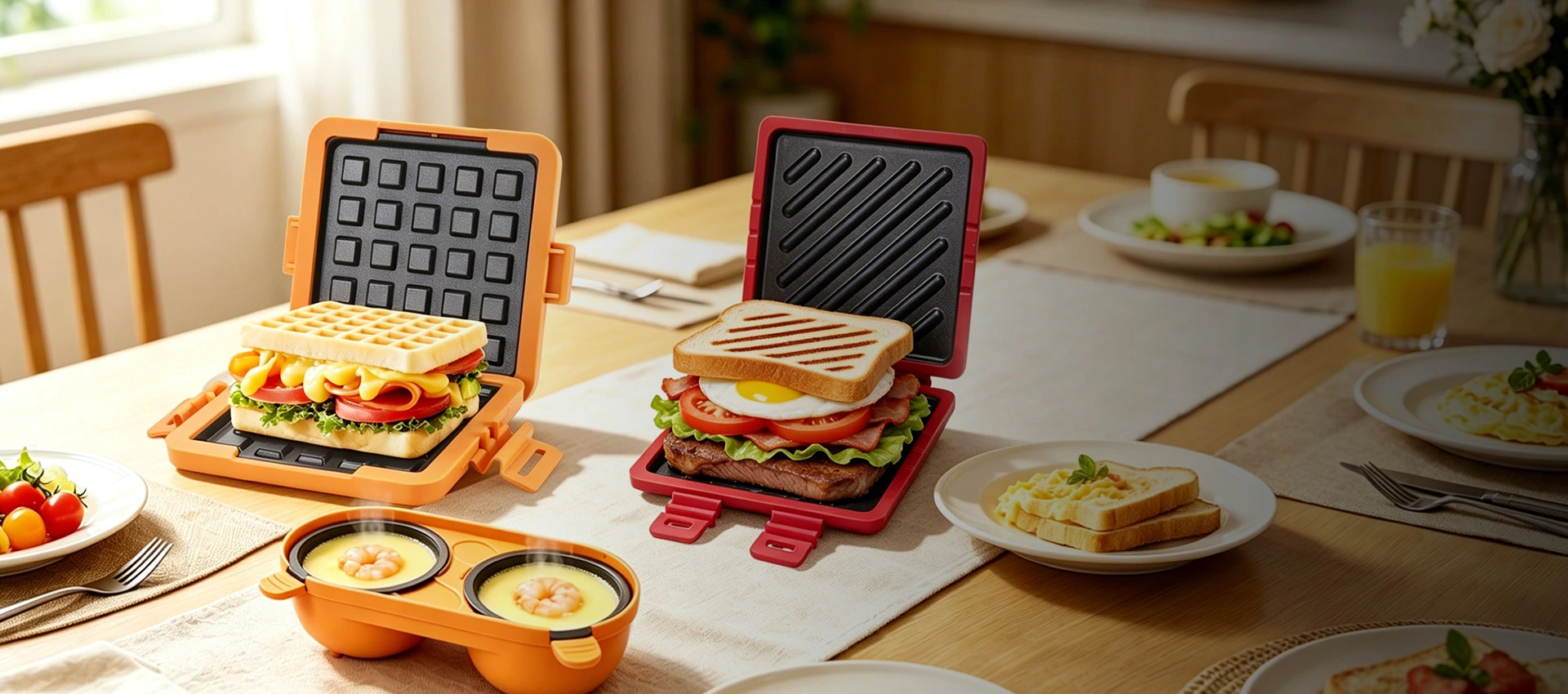
Most people learn early that metal and microwaves don't mix. A microwave grill pan is the deliberate exception. It is a pan built around a heat-conductive metal plate that is designed to sit inside a microwave oven and get hot — genuinely hot, hot enough to sear bacon and brown bread.
The point of the product is simple. A plain microwave heats food from the inside out by exciting water molecules, which is why microwaved bread turns soft and microwaved pizza turns rubbery. There is no hot surface anywhere in the process, so there is no browning, no crust, no grill marks. The grill pan puts that hot surface back into the equation. The plate reaches frying temperature, the food sits on it, and the contact side crisps while the microwave energy cooks the interior at the same time.
In our own product line, the pan is usually a two-part construction: the conductive base plate that does the searing, and a food-grade silicone shell or lid around it. The silicone part matters more than it looks. It keeps heat and steam close to the food, gives the user something safe to grab, and on sandwich-style models it locks the two halves together so the bread presses against the hot surfaces from both sides.
The category goes by several names in different markets — microwave grill pan, microwave grill tray, microwave crisper pan, microwave toaster tray. The engineering underneath is the same family. If you are researching suppliers or comparing listings, treat these terms as one product category with different form factors, which we break down in section 3.
2. How Does a Microwave Grill Pan Work?
The working principle rests on one material choice: the base plate is made to absorb microwave energy rather than reflect it.
Ordinary metal cookware reflects microwaves, which is why it stays cold in the oven and why thin or sharp metal (a fork, crumpled foil) causes arcing. A microwave grill pan uses a plate engineered to do the opposite — it converts the absorbed energy into heat within the plate itself. The same principle appears in the silver susceptor liner inside a microwave popcorn bag, scaled up into a rigid, reusable cooking surface with a non-stick coating.
In practice, a cooking cycle looks like this:
- Preheat. The empty pan goes into the microwave for a short run on high power. During this stage nearly all the microwave energy goes into the plate, and its temperature climbs quickly.
- Contact cooking. Food goes onto the hot plate. The surface in contact with the plate sears and dehydrates — this is where browning and crisping come from.
- Simultaneous microwave cooking. While the plate works on the outside, microwave energy that isn't absorbed by the plate continues to heat the food from within. This dual action is why a grill pan cooks faster than a stovetop pan for many items: the inside and outside cook at the same time rather than in sequence.
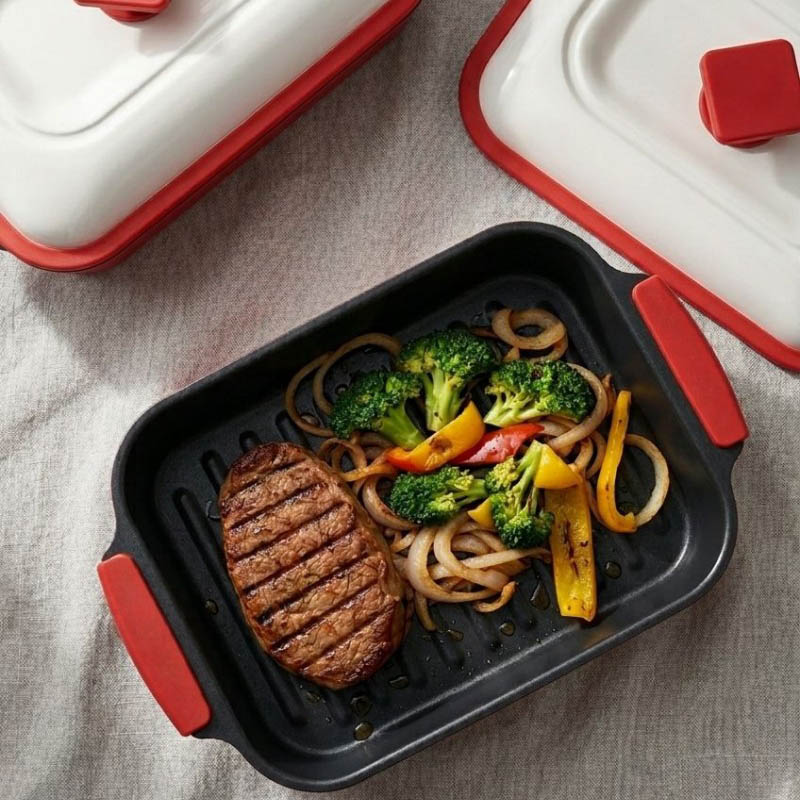
The structure around the plate shapes the result. Our designs pair the heat-conductive base with a silicone locking shell for a specific reason: the shell improves how microwave energy is distributed around the food and reduces the moisture buildup that normally makes microwaved food soggy. On grill-tray models we use a raised wave-pattern surface instead of a flat plate, which does two jobs at once — it leaves grill marks, and it lifts the food slightly so rendered fat drains away from the contact surface instead of pooling under it.
One design detail worth understanding: the plate is a continuous, rounded piece with no sharp edges or thin protrusions. Arcing in a microwave happens where electric fields concentrate at points and edges. A properly engineered grill plate avoids those geometries entirely, which is what separates it from the "no metal in the microwave" rule you learned at home.
3. What Types of Microwave Grill Pans Are There?
The category splits into a few practical form factors. The table below reflects how we organize our own manufacturing lines, and it maps closely to how the products are listed in most retail channels.
| Type | Structure | Best For | Typical Buyer Channel |
|---|---|---|---|
| Grill / toaster tray | Ridged or wave-pattern conductive plate, non-stick coating, silicone handles | Toast, bacon, reheated pizza, grilled vegetables | E-commerce, supermarkets, TV shopping |
| Sandwich maker (clamshell) | Two heated plates in a silicone locking shell, presses food from both sides | Sandwiches, paninis, quesadillas | E-commerce, gift and novelty retail |
| Grill multi-pot | Deeper pot body with conductive base and lid | One-pot meals, steaks, soups, low-oil cooking | Home goods retail, brand private label |
| Novelty / shaped tray | Standard plate with embossed patterns (cartoon shapes, custom designs) | Character toast, licensed-brand products, gifting | IP licensing, cross-border e-commerce |
The novelty segment deserves a note because it behaves differently from the rest. A plain grill tray competes on function and price. A shaped or licensed tray competes on the design itself — the embossed pattern it leaves on the toast is the product. In 2025 we manufactured a licensed cartoon-brand cooking pot for the Japanese market, where the brand's color codes, logo placement and packaging all had to pass approval before mass production. For buyers building a branded or IP-based line, this is the segment where a manufacturer's customization discipline gets tested, and we cover what to check in section 7.
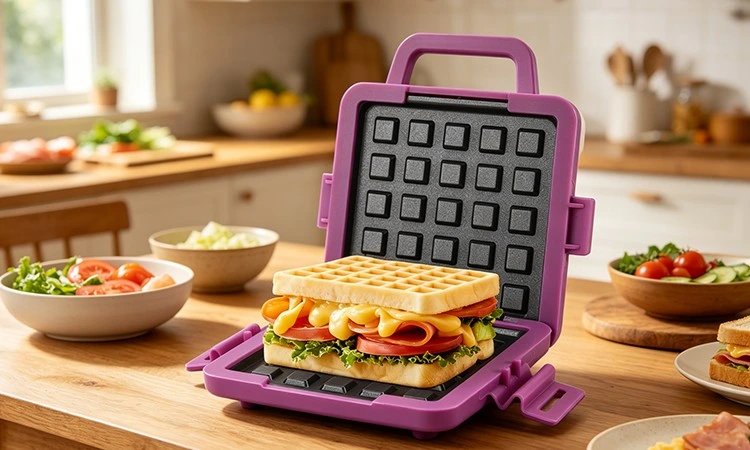
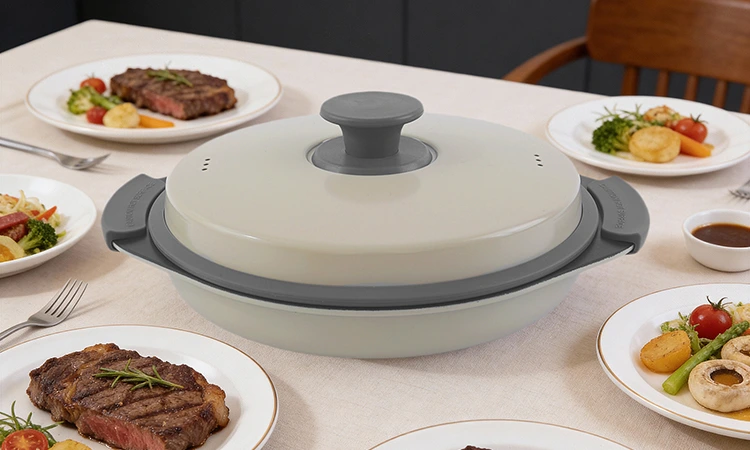
Within our own catalog, these form factors correspond to two product families: the Microwave Toaster Grill Tray series and the Microwave Grill Multi-Pot series.
4. What Can You Cook in a Microwave Grill Pan?
The honest answer: anything that benefits from a hot contact surface and doesn't need deep, sustained dry heat. The pan is not an oven replacement. It is a fast, small-format grill for a machine that every office, dorm and hotel room already has.
Where it performs well
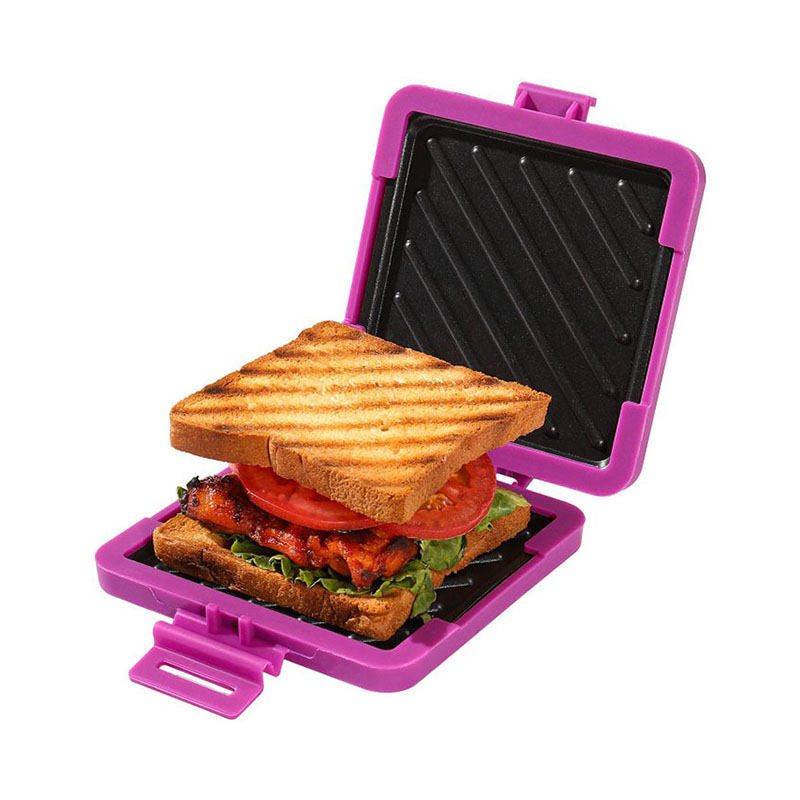
- Toast and sandwiches. The original use case. Bread browns on the plate instead of steaming soft, and clamshell models toast both sides at once.
- Bacon. A strong match for the ridged tray — the raised pattern lets fat drain off while the plate crisps the strips, with far less splatter than a stovetop.
- Reheated pizza and fried food. The single biggest quality gap versus a plain microwave plate. The hot surface re-crisps the base instead of turning it rubbery.
- Thin proteins. Thin steaks, burger patties, chicken fillets, fish. Contact heat sears the outside while microwave energy cooks the inside, which shortens total time.
- Vegetables. Sliced zucchini, peppers, onions — grill marks and light charring rather than the steamed texture a bowl gives you.
- Eggs and breakfast items. A flat non-stick plate handles fried eggs and hash browns without a stove.
Where it has limits
- Thick cuts of meat. The microwave portion of the cooking can leave uneven doneness in thick pieces. Anything substantial should be checked with a food thermometer.
- Large-batch cooking. Plate area is fixed by what fits in a microwave. It is a one-to-two portion tool.
- True baking. The pan crisps surfaces; it does not create the enclosed dry-heat environment that pastry and bread baking need.
These use cases point at where the product sells: home kitchens, office pantries, hotel rooms, student dormitories — anywhere the microwave is the only cooking appliance available. That context is worth keeping in mind if you are positioning this product for a retail audience, because the marketing story is less "a better grill" and more "a real cooked meal from the only appliance you have."
5. Microwave Grill Pan vs. Stovetop Pan vs. Electric Grill
Retail buyers ask us this constantly, usually phrased as "why would a consumer choose this over a real pan?" The comparison below is the practical answer.
| Factor | Microwave Grill Pan | Stovetop Grill Pan | Electric Sandwich Grill |
|---|---|---|---|
| Heat source needed | Microwave only | Gas or induction stove | Dedicated wall outlet appliance |
| Cooking action | Contact sear + internal microwave heating simultaneously | Contact heat only, outside-in | Contact heat from two plates |
| Open flame / exposed element | None | Yes (gas) or hot element | Enclosed element |
| Splatter and cleanup | Contained in shell; non-stick plate wipes clean | Open splatter, heavy pan to wash | Fixed plates, harder to wash fully |
| Storage footprint | Compact, light; silicone parts tolerate tight storage | Heavy cast iron or steel | Countertop appliance space |
| Usable in dorms / offices / hotels | Yes — this is the core scenario | Rarely (no stove access) | Sometimes restricted by building rules |
| Sear quality ceiling | Good for thin items; below cast iron for thick cuts | Highest | Moderate |
The pattern is clear: the stovetop pan wins on raw searing power, and the microwave grill pan wins everywhere access, safety rules or space are the constraint. The two products barely compete for the same customer. The closer commercial rivalry is with the electric sandwich grill — and there the microwave pan's advantages are price point, zero counter space, and no additional appliance to own.
6. Are Microwave Grill Pans Safe?
Two safety questions come up, and they have different answers.
Is the metal plate safe in a microwave?
Yes, when the pan is engineered for it. As covered in section 2, arcing is a geometry problem — it happens at sharp edges, points and thin metal. A microwave grill plate is a continuous rounded piece designed to absorb energy rather than concentrate it. The rule to give end customers is simple: use cookware built for microwave use, and never improvise with ordinary metal pans, foil or racks.
Are the materials food-safe at grilling temperatures?
This is the question that separates manufacturers, because the pan combines three materials that all face heat: the plate, its non-stick coating, and the silicone shell.
Silicone's suitability comes from its chemistry. Its backbone is a silicon–oxygen (–Si–O–) chain with no carbon double bonds, which makes it more resistant to heat, UV and ozone degradation than most polymer materials. That stability is why food-grade silicone is the standard shell and handle material across this category, and why the shell can sit against a plate at frying temperature without softening or off-gassing the way cheaper plastics would. In our own multi-cook pot line, the food-contact silicone is tested according to FDA and LFGB standards and rated for temperatures from −40°C to 230°C, which comfortably covers both freezer storage and microwave grilling in a single vessel.
Because decoration also faces heat, we validate printed elements the same way we validate the structure. When we ran silkscreen logo work for a licensed-brand production run, the printed silicone was cured at 120–150°C, then a finished sample was microwaved continuously on high for 30 minutes — the logo showed no softening, peeling or discoloration. Cross-cut adhesion testing after tape peel left less than 5% coating loss, and the logo stayed legible after repeated rubbing under 500 g of force. If a supplier cannot describe tests like these for their own product, that is a signal worth acting on.
For end users, safe use comes down to three habits: follow the preheat time in the product manual rather than guessing, handle the pan by its silicone parts (the plate is genuinely hot), and check thick proteins with a food thermometer as you would with any cooking method.
7. What Should Importers Check Before Ordering?
This section is for the distributors, importers and e-commerce brands this category is largely built for. A microwave grill pan looks like a simple product on a listing page. From the factory side, the quality differences hide in five places.
1. Plate performance, not plate appearance
Two visually identical trays can heat very differently. Ask the supplier how fast the plate reaches working temperature at a stated microwave wattage, and whether heating is even across the surface. Uneven plates produce toast that is browned in the center and pale at the edge — the number one complaint driver in reviews for this category.
2. Coating durability
The non-stick coating takes both thermal cycling and utensil contact. Ask what abrasion and adhesion testing the coating passes, and how many heating cycles the supplier has validated. A coating that fails at month three turns into a return rate problem at month four.
3. Silicone quality and documentation
Food-contact silicone should come with material documentation appropriate to your target market's regulations. Verify the paperwork matches the actual production material, not just a showroom sample. For reference, our own food-contact silicone is tested to FDA and LFGB standards, and the factory operates under BSCI and ISO9001 certifications. Request compliance documents early — before tooling, not after.
4. Customization discipline
If you are building a private label or licensed product, the supplier's tolerance control is the whole game. Concrete numbers to ask for: logo placement deviation across a full production run, packaging color difference (ΔE), and whether the supplier requires brand approval checkpoints before mass production. In our own licensed-brand run of 5,000 units, placement deviation was held within ±0.5 mm and packaging ΔE within 1.5 — those are the kinds of figures a capable factory can quote from its own records without hesitation.
5. Sampling before commitment
A sample in your own microwave tells you more than any spec sheet. Test the preheat, cook the foods your market actually eats, wash it twenty times. We offer free trials of new products for this reason — the category is tactile, and buyers who test first negotiate from knowledge rather than guesswork.

As production background: HeMaSe products are manufactured by Ningbo Sai'an Intelligent Technology Co., Ltd., established in Cixi, Ningbo. The company runs its own R&D, quality inspection and foreign trade departments, holds BSCI and ISO9001 certifications, and supplies OEM and ODM programs for distributors, importers, retailers, supermarkets and e-commerce brands — with low-MOQ programs (from 1,000 pieces on selected models) and one-stop customization from design drawings to mold development.
8. Frequently Asked Questions
Does a microwave grill pan really make food crispy?
Yes, within limits. The plate heats up like a small frying surface, so whatever touches it browns and crisps. It won't imitate a charcoal grill, but next to a plain microwave plate the difference shows up on the first slice of toast.
Is it safe to put a metal grill pan in the microwave?
A pan built for the job, yes. The plate is a continuous rounded surface with no sharp edges — the geometry that causes arcing with forks and foil simply isn't there. The rule against metal in microwaves still applies to everything not designed for it.
How long does the pan take to preheat?
A few minutes empty on high power in most cases, though it varies with microwave wattage and plate size. The product manual for the specific model is the number to trust, not a general figure.
What's the difference between a grill pan and a crisper tray?
Same principle, different structure. A crisper tray is a flat plate for pizza and snacks. A grill pan adds ridges for grill marks and fat drainage, and often a silicone shell or press for sandwiches.
Can it cook raw meat?
Thin cuts cook well — bacon, patties, fillets. Thick cuts are harder to judge inside a microwave, so use a food thermometer before serving.
Can these be customized with our brand?
Yes. Shell colors, embossed patterns, silkscreen logos and retail packaging are all standard OEM work for us, with brand approval checkpoints before mass production for licensed projects.
Testing suppliers for a microwave grill pan program?
The fastest way to evaluate this category is to run a sample in your own microwave. Tell us your target market and channel, and we'll recommend the right form factor from our grill tray and multi-pot lines — free trials available for new products.
Email ningboyoulekang@163.com