

The short answer
Microwave grill tray, crisper tray, crisper plate, crisper pan, browning tray and toaster grill nearly all describe the same thing: cookware with a heat-conducting plate that browns food inside a microwave. The names come from different regions and sellers, not different technology. Where they do differ is shape, and that is worth understanding: flat trays toast and grill, deeper pots handle steaks and soups.
We manufacture this category, and we see the confusion from both ends. Shoppers search six different names for one product. Importers then have to pick which name goes on the listing, which quietly decides how much traffic that listing gets.
This page decodes the terms, explains where the differences are real, and covers the one specification that matters no matter what the item is called.
The name decoder
Start with the table. Most people find their answer here and stop reading, which is fine.
| Name | What it usually means | Typical shape |
|---|---|---|
| Microwave grill tray | General term for the whole category, common with manufacturers | Flat, often with ridges |
| Microwave crisper tray | Same product, emphasis on the crisping result | Flat |
| Microwave crisper plate | Usually a flatter, simpler single-surface version | Flat, often lidless |
| Microwave crisper pan | Interchangeable with tray, sometimes implies deeper sides | Flat to shallow |
| Microwave browning tray or dish | The older term, still common in the UK and among long-time cooks | Flat or shallow dish |
| Microwave toaster grill | Emphasis on toasting and sandwiches, usually a clamshell | Hinged, double-sided |
| Microwave grill plate | Single grilling surface, often ridged | Flat |
| Microwave grill pot or multi-pot | Genuinely different, a deep sealed body for wet cooking | Deep, lidded |
| Microwave baking tray | Ambiguous and often a misnomer, see the warning below | Varies |
Seven of those nine are marketing variations on one product. Only the last two need care, and one of them is a trap.
The two names that are not just synonyms
Multi-pot is a real category difference
A deep, sealed pot is not a flat tray with a new label. It has a lidded body designed to hold moisture, which lets it handle steaks, soups and vegetables rather than only toasting and grilling. Our steak model cooks in 5 to 8 minutes at 800W and uses a gravity-fed lid so you do not flip the food. If a listing says pot, expect wet cooking. If it says tray, do not.
Genuinely differentMicrowave baking tray is the misnomer to watch
This name gets used for two completely different things. Sometimes it means a proper crisper tray. Sometimes it means an ordinary microwave-safe dish with no heat-conducting plate at all, which will never brown anything. This is a common source of disappointed reviews, because the buyer expected crisping and bought a container. Check the material description, not the name.
Check before buying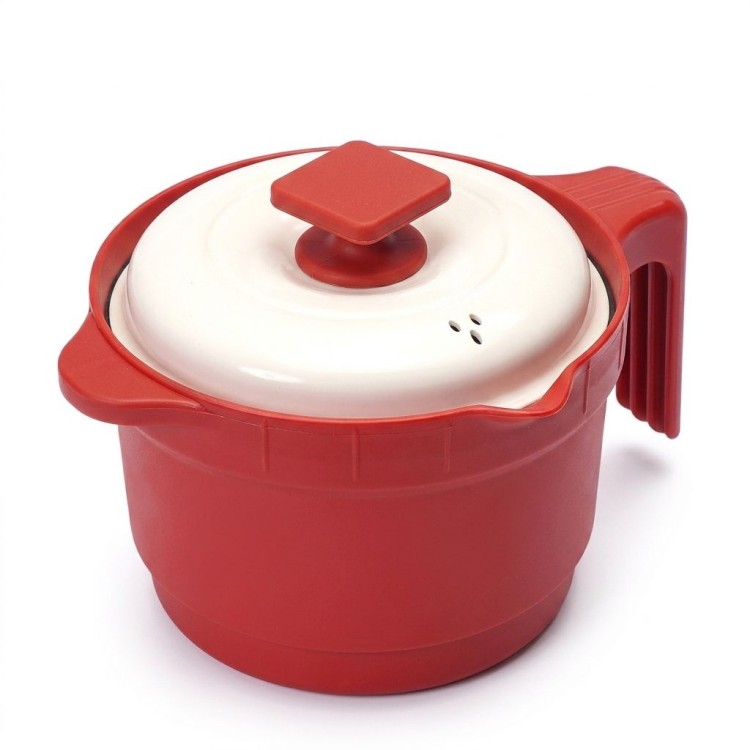
Why so many names exist
Three forces created this mess, and none of them was a conspiracy.
The first is region. Browning dish is the older British and European term, dating from when these products were sold as microwave accessories decades ago. Crisper became the dominant American word, and crisper pan is now the most searched variant in the United States.
The second is marketplace optimisation. Sellers name products after the outcome shoppers search for. Someone hunting for crisp bacon searches crisper, someone wanting grill marks searches grill, and listings follow that language rather than any technical standard.
The third is that no standards body ever defined the category. There is no official name to be right about, so every manufacturer, ours included, uses the term its customers use.
The one specification that matters, whatever it is called
Here is the part that actually protects you from a bad purchase.
Ignore the name and look for a heat-conducting plate. That layer, usually an aluminium or aluminized alloy plate bonded to a high-polymer thermal layer, is what absorbs microwave energy and turns it into contact heat. Without it, you have a dish. With it, you have a grill.
Our trays state it plainly in the material line: aluminium heat-conductive technology with a food-grade heat-resistant polymer structure, or food-grade silicone with an aluminized alloy heat-conducting plate and a non-stick coating, depending on the model.
Three checks that beat reading the product name
- Material line names a conductive plate. Aluminium, aluminized alloy or a thermal conductive polymer layer. Silicone alone is not enough.
- A stated temperature range. Ours run -40°C to 230°C on the silicone shells, with the square tray rated to 230°C for up to 30 minutes of continuous microwave heating. No range usually means no testing.
- Certification you can see. FDA and LFGB reports for the food-contact material, not a logo on a banner.
We went deeper on why the plate is the whole product in our test of whether crisper trays really work, and on the certification side in FDA versus LFGB for importers.
Which shape for which cooking
Since the names blur, choose by form factor instead. This is what actually changes your results.
| Flat single plate | Toast, bacon, reheated pizza. Simplest and cheapest, no lid to close. |
|---|---|
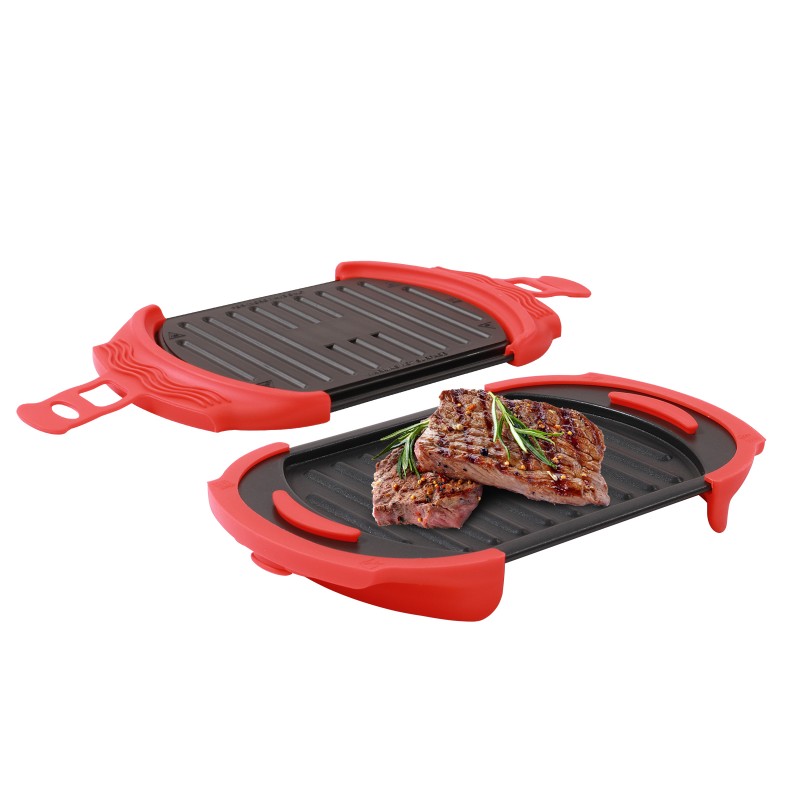
| Ridged grill tray | Grill marks and fat drainage. The 3D wave-pattern surface on our square tray guides grease away from the food. |
| Clamshell toaster grill | Sandwiches and paninis, cooked from both sides at once. Ours handles two standard slices plus fillings in 1 to 2 minutes. |
| Detachable multi-tray | Several jobs in one product, easier to clean. Our 3-in-1 uses a 0.3 mm thickened non-stick coating. |
| Deep multi-pot | Steaks, soups, steamed vegetables. Sealed body, 5 to 8 minutes at 800W. |
Once you have chosen a shape, technique matters more than branding. Cook times and the preheat step are in our guide to how to use a microwave grill tray.
For sellers: which name should go on your listing?
This is where the naming question stops being trivia and starts affecting revenue.
Buyers search different words in different markets, so the name on your listing decides which searches you are visible for. Pick one primary term and cover the rest in the description rather than trying to cram every synonym into the title.
| Market | Lead with | Cover in the description |
|---|---|---|
| United States | Crisper pan or crisper tray | Grill tray, browning tray, toaster grill |
| United Kingdom | Crisper tray, with browning dish nearby | Grill tray, toastie maker language |
| Germany and EU | Grill tray or crisper tray | Browning, toaster grill |
| Australia | Crisper tray or grill tray | Browning tray, sandwich press language |
Three rules keep this from going wrong. Do not invent a name nobody searches for, however clever it sounds. Do not stuff six synonyms into one title, because it reads as spam to shoppers and to marketplaces. Do name the format honestly, since calling a flat tray a pot creates returns you will pay for.
One private-label seller we work with had a strong product sitting almost invisible under a title built around a made-up brand phrase. Renaming it around the term shoppers actually type, with the synonyms moved into the bullet points, changed nothing about the product and everything about who found it.
How our range maps to the names
So you can translate between what you searched and what we make.
| Crisper tray, grill tray, browning tray | Our quick-cooking and square toaster grill trays |
|---|---|
| Toaster grill, sandwich maker | Our sandwich grill tray, clamshell with side clips |
| Multifunctional or 3-in-1 tray | Detachable double-sided trays in one product |
| Grill pot, multi-pot, soup pot | Our deeper sealed multi-pot line |
You can see the formats side by side across our full range of microwave grill trays and crisper cookware, and if you are sourcing rather than shopping, the commercial terms are in our sourcing and OEM guide.
What the names do not tell you about quality
A name says nothing about how well something is made. Two trays sold under the same words can behave completely differently, and the gap is always in the build rather than the branding.
The clearest example is the conductive plate. A thicker, properly bonded plate holds heat between rounds, so a second sandwich cooks faster than the first. A thin or partial plate loses temperature the moment food touches it, which is why some trays crisp the first item and steam the second.
The coating is the next difference. Our 3-in-1 uses a 0.3 mm thickened non-stick surface, and that thickness is what decides whether the coating survives daily use or starts sticking within months. It never appears in the product name.
Then there is the seal. A sealed buckle structure keeps oil and liquid inside during cooking, which matters more than shoppers expect. Trays without a proper closure leak, and a leaking tray generates returns no matter how well it browns.
Last is the silicone itself. Certified food-grade silicone with a tested range behaves predictably from freezer to microwave, while cheap filler-heavy silicone deforms or turns brittle. The name on the box is identical in both cases.
A short buying checklist
If you take one thing from this page, take this. Whatever the product is called, run through these five points before you buy or place an order.
- Does the material line name a heat-conducting plate? If not, it is a dish rather than a grill.
- Is a temperature range stated? Untested silicone has no range to quote.
- Is the format right for your food? Flat for toasting and grilling, deep pot for steaks and soups.
- Are FDA and LFGB reports available on request? Real testing is sent the same day.
- Does the closure actually seal? Buckles or clips prevent the leaks that drive returns.
Those five questions cut through every naming variation in this article, which is the point. The category has nine names and one specification that matters.
Not sure which format fits your market?
Tell us the market and channel you sell into and we will recommend a starter range, whatever you call it locally. FDA, LFGB and CE certified, MOQ from 500 pieces in stock colours, samples in 7 to 10 days. Email ningboyoulekang@163.com, call +86-15258301863, or message us on WhatsApp.
Frequently asked questions
What is the difference between a microwave crisper tray and a grill tray?
In practice, nothing. Both describe cookware with a heat-conducting plate that browns food in a microwave. Crisper emphasises the result and grill emphasises the ridged surface, but the technology is the same.
Is a microwave browning tray the same as a crisper tray?
Yes. Browning tray or browning dish is the older term, still common in the UK, for the same category of product.
What is the difference between a crisper plate and a crisper pan?
Mostly depth and marketing. A plate tends to be a flat single surface, while a pan may have slightly deeper sides. Neither name guarantees a difference in performance.
Is a microwave baking tray the same thing?
Not always, and this is the name to be careful with. Some microwave baking trays are ordinary microwave-safe dishes with no heat-conducting plate, so they will not crisp anything. Check the material description before buying.
What is a microwave toaster grill?
Usually a hinged clamshell tray that cooks from both sides, aimed at sandwiches and toast. Ours takes two standard slices plus fillings and cooks in 1 to 2 minutes.
Which name should I use on my product listing?
Lead with the term your market searches most, crisper pan or crisper tray in the US and grill tray or crisper tray in Europe, then cover the other names in the description rather than the title.