

A microwave grill pan manufacturer should be evaluated on more than a catalog photo and a unit price. Buyers need to match the product structure to the retail use case, approve a model-specific sample, verify relevant documents, define customization and packaging, and agree on inspection evidence before mass production.
What Should a Buyer Expect From a Microwave Grill Pan Manufacturer?
A trading listing can show what is available. A manufacturer discussion should go further: it should identify the exact construction, explain which parts can be customized, provide a production sample, define packaging and inspection, and keep revisions traceable from quotation to shipment.
This article focuses on that commercial decision. If your team first needs the cooking principle, product types and user-level safety basics, read the existing microwave grill pan guide. Keeping those questions on a separate informational page prevents a supplier-selection page from becoming a general consumer article.
For an importer or private-label brand, the useful output of supplier evaluation is a controlled specification. It should state what will be produced, what evidence will be reviewed and what counts as an acceptable shipment. Without that document, two prices may refer to visibly similar but materially different products.
Product fit
The cooking format, portion size, microwave conditions and retail promise fit the target customer.
Production control
The approved sample, materials, dimensions, artwork, packaging and inspection method are tied to one SKU revision.
Commercial fit
The MOQ, customization route, pack-out and quotation match the buyer's channel and launch quantity.
Which Microwave Grill Pan Format Fits Your Market?
“Microwave grill pan” is often used as a broad buying term. Under it, a supplier may offer a locking toaster tray, a lidded cooking pot or another specialized shape. The right starting point is the meal and selling channel.
| Product format | Typical product brief | Buyer questions | HeMaSe range to review |
|---|---|---|---|
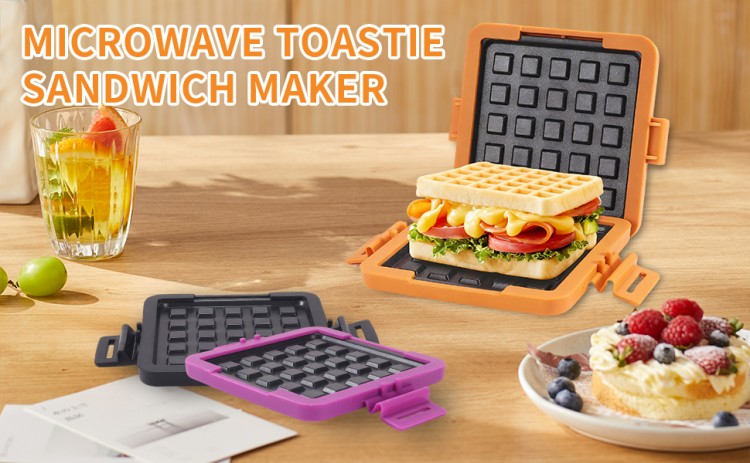
| Flat locking grill tray | Toast, sandwiches, reheating and compact portions held between two heated surfaces | Food size, closure pressure, buckle operation, surface pattern, power range and final recipe instructions | Microwave Toaster Grill Tray |
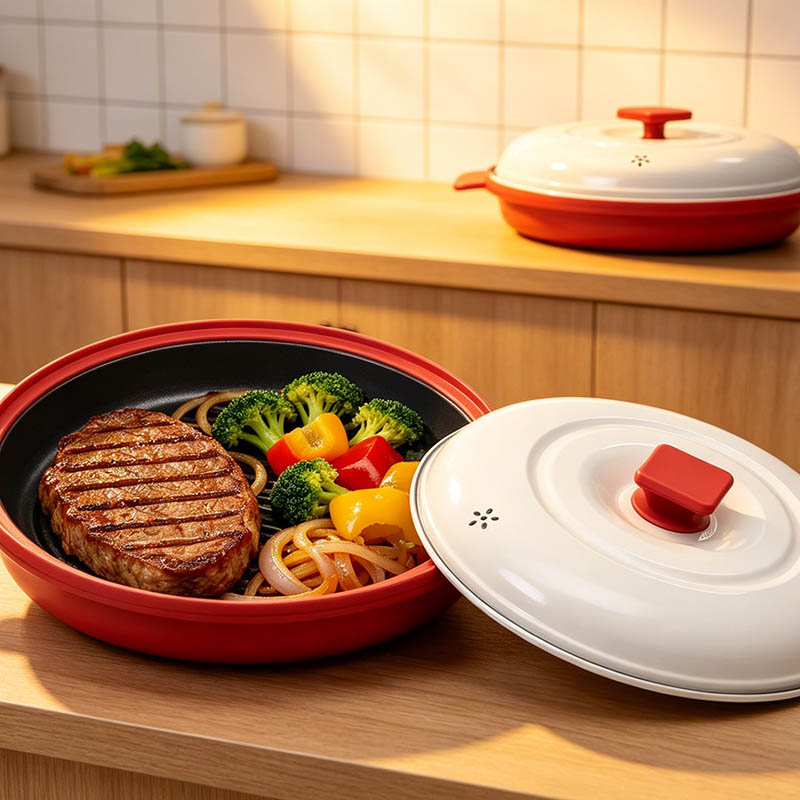
| Lidded grill multi-pot | Cooking, reheating or multi-use meals where capacity, lid seating and steam management matter | Capacity, overall size, lid design, relief feature, coating, microwave conditions and cleaning instructions | Microwave Grill Multi-Pot |
| Customized existing model | A private-label launch based on an available structure | Color, logo method, packaging, manuals, artwork approval, MOQ and sample route | Discuss the selected product page with the supplier |
| New tooling or structural change | A differentiated size, form or functional concept | Design inputs, tooling ownership, prototype stages, validation, change control, MOQ and schedule | Discuss feasibility before requesting a production quotation |
A useful product brief names the target food, portion, market, microwave wattage range, intended retail price band and packaging format. It also separates a required feature from a preference. This helps the manufacturer recommend an existing model before the buyer commits to unnecessary tooling.
Which Specifications Must Be Compared Between Suppliers?
Do not compare a family-level description such as “non-stick microwave grill pan.” Compare the named model and revision. Current HeMaSe pages illustrate why: different products use different constructions, capacities and microwave power listings.
| Current website-listed product | Published construction | Published size or capacity | Published microwave range |
|---|---|---|---|
| Quick Cooking Microwave Toaster Grill Tray | Silicone + polymer + aluminum plate; four symmetrical buckles | Suitable toast size listed as approximately 12 × 12 cm | The specification table lists 800W–1200W |
| Food Grade Microwave Multi Cook Grill Pot, SN-0077G | Silicone + aluminized steel plate + PTFE coating | 27 × 22.8 × 8.6 cm; 800 ml | 700W–1000W |
| Large Capacity Non-Stick Microwave Grill Pan with Lid | Silicone + aluminized plate; matching silicone lid | 25.3 × 16.1 × 8.7 cm; 1000 ml | Confirm the approved test conditions for the order |
These figures should remain attached to their individual models. A buyer should not turn one product's power range, capacity or material description into a claim for every microwave grill pan in a supplier's range.
Build a one-page comparison sheet
Ask each shortlisted microwave grill pan manufacturer to fill the same fields: model number, revision, overall dimensions, usable cooking area or capacity, component materials, coating, product weight, intended microwave power range, closure or lid system, unit packaging, carton quantity, carton dimensions, customization method and applicable documents. Add a column for “supplier evidence” so that a drawing, report, sample photo or packaging file can be traced to each answer.
How Should Buyers Evaluate OEM and Private-Label Options?
OEM is not one fixed service. A buyer may select a standard model, change color, add a printed or engraved logo, redesign the retail box, localize instructions or request a structural change. Each step can alter sample work, MOQ, tooling and approval time.
- Start with the smallest necessary change. If the existing product fits the intended meal and channel, color, branding and packaging may be enough for a first launch.
- Name the logo process. Printing and mold engraving are different operations. Confirm artwork size, position, color reference and durability expectations.
- Approve packaging as part of the product. The box, instructions, barcode, labels, carton marks and pack-out should be in the purchase specification.
- Treat a structural change as a development project. Agree on drawings, prototypes, tooling responsibility, test requirements and revision approval before setting the mass-production basis.
The current SN-0077G page lists a standard-product MOQ of 1,000 pieces, 3,000 pieces for pad printing and 5,000 pieces for mold engraving. Those are model-page figures, not a company-wide MOQ schedule. Another product can have different terms, so request a current written quotation for the exact model and customization combination.
What Should Be Checked Before Mass Production?
A sample is useful only when it represents the specification being approved. Record the model, revision, materials, color, artwork and packaging status. If a later change is agreed, update the revision instead of relying on scattered messages.
Pre-production approval checklist
- Model number, drawing and revision match the quotation
- Materials and coating match the written specification
- Dimensions, usable area or capacity suit the target food
- Lid, buckle, handle or closure works consistently
- Microwave test follows the intended wattage, food load and time
- Surface condition and cleaning instructions are acceptable
- Color, logo size, position and method match approved artwork
- Retail box, manual, warning text, barcode and carton mark are approved
- Required reports can be traced to the relevant product or material
- Final inspection scope and shipment evidence are agreed
Verify compliance evidence by destination market
Do not accept “FDA” or “LFGB” as a label without reviewing the underlying report and its scope. Check the tested material, model or component, test method, laboratory, date and whether the result supports the claims planned for your sales market. HeMaSe's microwave cookware certification guide explains the questions buyers should ask. The buyer or its compliance adviser remains responsible for deciding which requirements apply in the destination market.
Define inspection before production starts
The purchase file should specify the approved sample, appearance reference, dimensions, functional test, branding, packaging and acceptance method. The current SN-0077G page states that sample evaluation is available before production and that third-party or recorded video inspection can be arranged. Confirm the scope, cost, timing and acceptance process for the actual order.
For a wider sequence from inquiry through shipment, use the microwave cookware sourcing guide.
How Can Importers Compare Microwave Grill Pan Quotations Fairly?
First freeze the comparison basis. The product model, materials, coating, dimensions, accessories, logo, packaging, quantity, inspection and trade terms should be the same for every supplier. Then ask each supplier to separate standard product cost from customization, tooling, packaging, testing, samples and freight-related charges.
| Quotation field | Why it matters | Evidence or clarification to request |
|---|---|---|
| Exact model and revision | Prevents a lower price from referring to another structure | Drawing, specification or signed sample reference |
| MOQ by customization level | Stock, printing, engraving and new tooling may have different thresholds | Separate quantity and price break for each option |
| Unit and master packaging | Pack-out affects landed cost, damage risk and retail readiness | Box dimensions, carton quantity, carton size, gross/net weight and artwork responsibility |
| Sample and approval route | Shows what becomes the production reference | Sample type, fee, delivery method and revision process |
| Inspection and documents | Defines evidence required before shipment | Report list, inspection option, test method and acceptance rule |
| Commercial terms | Unit prices are not comparable without the same basis | Currency, Incoterm, payment terms, quotation validity and production timing |
A low initial quote can become expensive if artwork, packaging, testing, tooling or inspection is added later. A complete quotation gives the buyer a clearer landed-cost model and reduces negotiation based on assumptions.

What Can Buyers Discuss With HeMaSe?
HeMaSe is the brand of Ningbo Sai'an Intelligent Technology Co., Ltd. According to the current company profile, the business is based in Cixi, Ningbo and focuses on microwave cookware and silicone kitchenware, with R&D, quality-control and foreign-trade functions.
For microwave grill pan sourcing, buyers can begin with the existing locking grill-tray range or lidded multi-pot range. Current product pages describe options including logo, color, packaging and structural customization, but availability and minimum quantities depend on the selected model and process.
A productive first conversation should identify the destination market, sales channel, food use, microwave range, target quantity and desired customization. HeMaSe can then respond against a named model or discuss whether a new development route is needed.
What Should You Send in a Microwave Grill Pan RFQ?
Copy the template below and replace the brackets. It gives the supplier enough context to recommend a model and separate confirmed facts from open questions.
Frequently Asked Questions
What is a microwave grill pan manufacturer?
A microwave grill pan manufacturer produces cookware designed for microwave grilling, browning or multi-use cooking. For B2B sourcing, the manufacturer should be able to define the exact product structure, provide a sample, support agreed customization and packaging, and document production and inspection requirements.
Does HeMaSe offer OEM or private-label microwave grill pans?
Current HeMaSe product pages describe customization options that include color, logo, packaging and, for selected products, structural development. The available process and minimum quantity depend on the model and customization method, so buyers should request a current written quotation.
What is the MOQ for a wholesale microwave grill pan?
There is no single MOQ for every product or customization route. For example, the current SN-0077G page lists 1,000 pieces for the standard product, 3,000 pieces for pad printing and 5,000 pieces for mold engraving. Confirm the MOQ for the selected model, packaging and current quotation.
Should an importer test a sample before ordering?
Yes. Test the approved sample with the intended food, load, microwave wattage and user instructions. Also check dimensions or capacity, closure or lid function, surface condition, cleaning, artwork and packaging. Keep the approved sample and specification as production references.
Which documents should buyers request from a supplier?
Request the model specification, drawing or dimensions, materials information, relevant food-contact or material reports, packaging data, artwork approval, inspection plan and shipment records required by the purchase order. Verify that every report applies to the actual product or material and the destination-market requirement.
How do I compare two microwave grill pan suppliers?
Give both suppliers the same product brief and compare the exact model, materials, dimensions, microwave range, sample, customization, MOQ, packaging, reports, inspection, trade terms and quotation validity. Do not compare unit price until the specification and commercial basis are aligned.
HeMaSe · Ningbo Sai'an Intelligent Technology Co., Ltd. · Cixi, Ningbo, China
Source Your Microwave Grill Pan Directly From HeMaSe
Start with a HeMaSe Microwave Toaster Grill Tray or Microwave Grill Multi-Pot, or send us your private-label brief. Our team will respond against a named model and confirm its construction, dimensions or capacity, applicable microwave range, MOQ, sample route, logo, color and retail-packaging options, and inspection arrangement in the written quotation.
Email: ningboyoulekang@163.com · Tel / WhatsApp: +86 152 5830 1863
Send Your RFQ to HeMaSe