

The short version
Sourcing microwave crisper cookware from China takes four steps: shortlist real factories rather than traders, verify FDA and LFGB food-contact certification, order samples (7-10 days), then run private-label production (25-30 days after approval). Realistic minimums are around 500 pieces in stock colors and 1,000 pieces for custom logo or color. Budget 30 to 45 days from first sample to goods leaving the factory.
We are the factory, so read this with that in mind. It also means the numbers below are the ones we quote buyers every week, not estimates copied from a directory listing.
This guide covers what to verify, what to pay, how long each stage takes, and the warning signs that a supplier will cost you an order. If you are still deciding which product to stock, start with our microwave crisper pan buyer's guide first, then come back here for the sourcing side.
Step 1: Work out whether you are talking to a factory or a trader
This is the first fork in the road, and it decides how the next two years go. Both can sell you goods. Only one can change them.
A trading company forwards your questions to a factory and sends the answer back, usually a day later and slightly wrong. A manufacturer answers from the floor. When you need a wall thickness adjusted, a coating changed, or a mold engraved with your logo, the trader has to negotiate it and the factory just quotes it.
Three questions separate them quickly. Ask which departments they run in-house, ask what equipment produces your item, and ask for the factory address and audit reports. We answer those with a research and development department, a quality inspection department, and a foreign trade department; vulcanizing and molding equipment on site; and an address in the Andong Industrial Zone, Cixi, Ningbo, that you are welcome to visit or audit.
You do not need a factory for every product. For a commodity you will never modify, a trader is fine. For a private-label line you plan to iterate on, the gap shows up on your second order and never closes.
Step 2: Verify certification before you discuss price
Price is the easiest thing to fix and the worst thing to lead with. Compliance is the opposite: cheap to check now, expensive to discover at customs.
Microwave crisper cookware is food-contact silicone, so it sits under food-contact regulation in every market worth selling to. Ask for the actual test reports, not a logo on a web page.
| Certification | What it covers | Matters most for |
|---|---|---|
| FDA | Food-contact material compliance | United States |
| LFGB | Stricter German and EU food-contact testing | Germany, wider EU |
| CE | EU conformity marking | European market entry |
| BSCI | Social compliance audit of the factory | Retail chains and large accounts |
| ISO 9001 | Quality management system | Consistency across repeat orders |
Our cookware carries LFGB, FDA, and CE food-contact certification, and the factory holds BSCI and ISO 9001. We also hold international design patents on several models, which matters more than most buyers realize.
That last point is worth a sentence. If you build a brand on a shape someone else owns, a takedown on a marketplace listing can end the SKU overnight. Ask any supplier whether the design is theirs to sell you.
Step 3: Understand the real MOQ and what drives your price
"Low MOQ" means nothing until it is attached to a number. Here are ours, plainly.
| MOQ, stock colors | 500 pieces |
|---|---|
| MOQ, custom color or logo | 1,000 pieces |
| Sample lead time | 7-10 days |
| Mass production | 25-30 days after sample approval |
| Payment terms | T/T 30% deposit, 70% against B/L copy; L/C at sight; PayPal for sample orders |
| Export markets | USA, EU, Australia |
Notice the two-tier MOQ, because it is the single most useful thing in this guide for a first order. Testing the category in stock colors halves your commitment. You only step up to 1,000 pieces when you commit to your own color and logo, by which point you have sell-through data to justify it.
What actually moves the unit price
Four things, roughly in order of impact. Order quantity comes first, since silicone molding rewards volume more than most processes. Then the format: a flat tray costs less to produce than a deep multi-pot with a lid and a hinge.
Third is customization. Logo pad printing is inexpensive; mold engraving costs more upfront but looks integrated and cannot rub off. A fully new mold is a real investment and should be reserved for a product you intend to own.
Fourth is packaging. A plain export carton and a full retail color box are different products commercially, and the box can be a meaningful share of your landed cost. Decide early, because it affects carton dimensions and freight.
Step 4: Read the spec sheet like a buyer, not a shopper
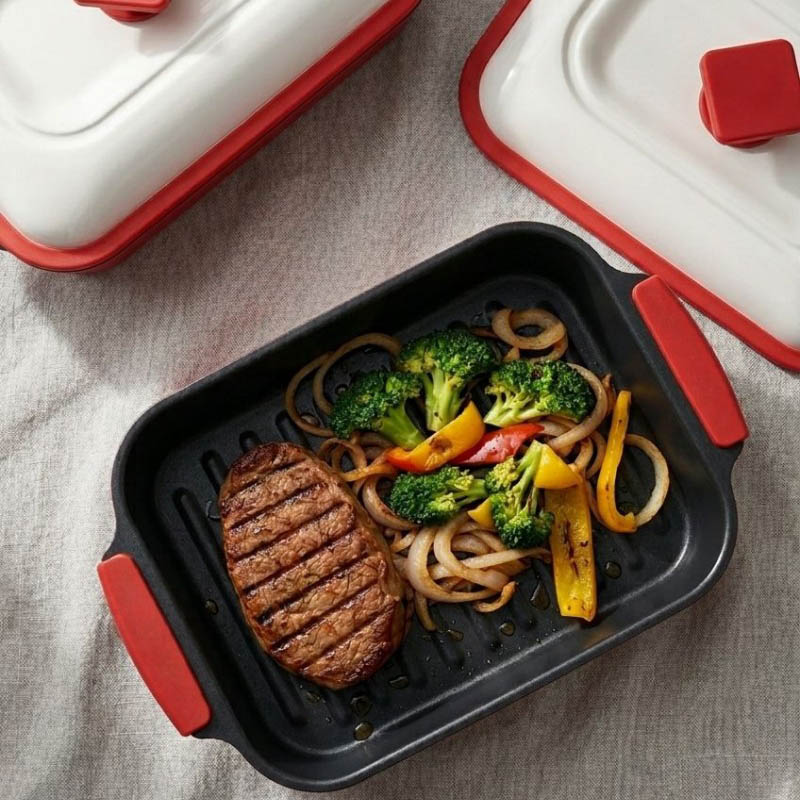
A supplier who cannot give you numbers has not tested the product. Here is the level of detail you should expect, using one of our own models as the example.
| Material | Food-grade silicone (LFGB/FDA grade) + aluminized alloy heat-conducting plate + PTFE coating |
|---|---|
| Dimensions | 25.3 × 16.1 × 8.7 cm |
| Gross weight | 666.6 g |
| Temperature resistance | -40°C to +230°C |
| Microwave requirement | 700W minimum |
| Cooking time | 5-8 minutes at 800W |
Three of those lines do more work than the rest. The material line tells you whether there is a genuine heat-conducting plate inside, which is the part that makes the product work at all. The temperature range tells you the silicone has actually been tested. The wattage requirement protects you from returns, because a customer running a 600W microwave needs to know that before buying, not after.
Weight and dimensions are your freight math. Ask for carton quantity and carton size at the same time, or your landed cost will surprise you.
Step 5: Run the order, stage by stage
1. Brief and quotation
Send your target market, channel, quantity, and whether you need custom color, logo, or packaging. A serious supplier quotes against those variables rather than sending a single number.
A few days2. Samples
Order samples and test them across several microwave wattages, not just yours. We turn samples in 7 to 10 days, and accept PayPal at this stage so a small buyer is not wiring money to a stranger.
7-10 days3. Customization and approval
Confirm color, logo method, and packaging. We can work from your drawings or produce sketch designs based on a sample you send us, then take it through to mold development. Approve in writing, with photos of what you approved.
Varies with tooling4. Mass production
Production runs 25 to 30 days after sample approval. Deposit is 30% by T/T, with the 70% balance against a copy of the B/L, or an L/C at sight if you prefer bank-mediated terms.
25-30 days5. Inspection and shipping
Inspect before the balance payment, either with your own agent or a third party. Then ship to the USA, EU, or Australia. Confirm whether your quote is FOB or DDP, since that single letter changes who handles duties.
Market dependentAdd it up and a realistic first order runs 30 to 45 days from sample request to goods leaving the factory, longer if you develop a new mold. Anyone promising dramatically less is either holding stock or not telling you the whole timeline.
Red flags that should end a supplier conversation
- Certificates that never arrive. A supplier with real FDA and LFGB reports sends them the same day. Delay here means they do not exist.
- No stated temperature range or wattage. Missing numbers mean untested product, and untested silicone is the failure everyone in this category has seen.
- A price far below everyone else. In crisper cookware, that gap is almost always the heat-conductive plate being thinned or omitted, which is exactly the part that makes it crisp.
- Refusing samples, or charging strangely for them. Sampling is normal and cheap. Resistance to it is a signal about what the sample would reveal.
- Vague answers about who owns the design. If they will not confirm the design is theirs to license, your listing is exposed.
The third one deserves emphasis, because it is the trap specific to this product. Two trays can look identical in photos while only one contains a real conductive base. We wrote up what that difference does in practice in do microwave crisper trays really work, and it is the same reason cheap units generate one-star reviews.
Choosing your first product mix
Most buyers over-order the impressive product and under-order the one that sells. The pattern is consistent enough to plan around.
Flat trays are your volume. They are the cheapest to land, the easiest to photograph, and they answer the search demand people actually have. Our sandwich grill tray and quick-cooking tray are the workhorses here.
Multi-pots are your margin. A deeper grill pot commands a higher price and gives you a bundle to upsell into, but it will not carry a catalog on its own.
Novelty and licensed shapes are your differentiation. A cartoon-embossed or custom-shaped tray competes on design instead of price, which is the only durable escape from a race to the bottom.
If you sell into markets where air fryers dominate the conversation, our breakdown of crisper pan versus air fryer is useful for writing listings that meet that objection head-on.
What private label actually looks like with us
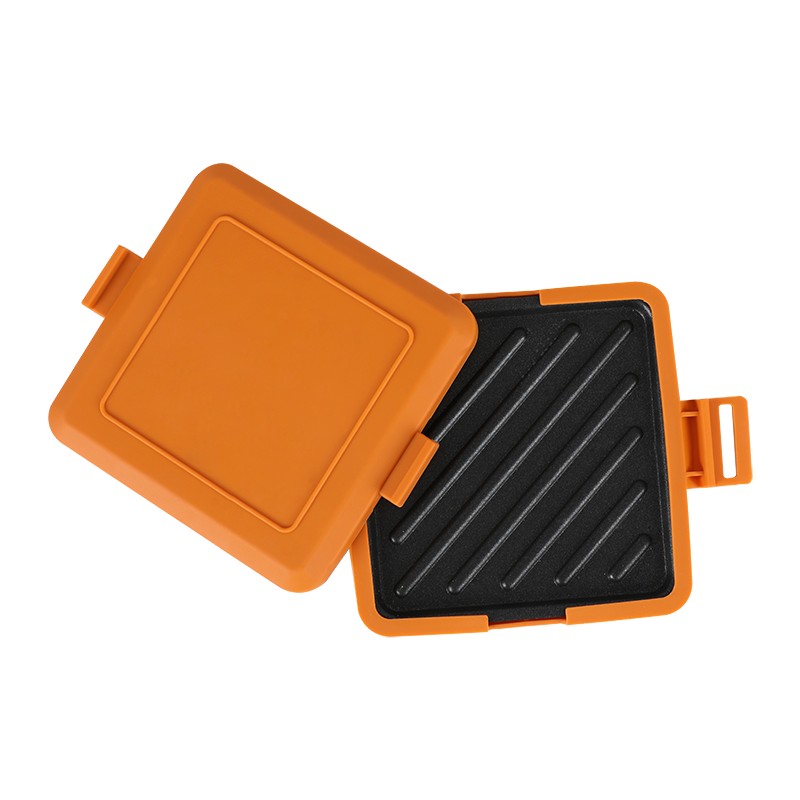
Customization runs on a ladder, and you do not need to climb it all at once.
The first rung is logo pad printing on an existing model, available at 1,000 pieces. The second is a custom color, again from 1,000. The third is mold engraving, where your mark is part of the tooling rather than printed on top. The fourth is full development, from design drawings through mold making, for a shape that is yours.
We also produce sketch designs from a sample you send, which is how most buyers start when they have a reference product but not a drawing.
Two examples of where that ladder leads. In 2025 we manufactured a licensed multi-functional microwave cooking pot for the Snoopy brand in Japan, a market that inspects color, print, and packaging harder than almost anywhere. We also produced a customized batch for Volkswagen Japan as corporate gifts, combining everyday usefulness with brand display.
Those two matter to you for one reason. A factory that has passed licensed-brand and automotive-client approval has already been audited by people stricter than your QC checklist.
Ready to price your first order?
Send us your target market, channel, and quantity, and we will come back with a quotation, full FDA, LFGB, and CE documentation, and samples in 7 to 10 days. MOQ starts at 500 pieces in stock colors. Email ningboyoulekang@163.com, call +86-15258301863, or message us on WhatsApp.
Frequently asked questions
What is the MOQ for microwave cookware from a China manufacturer?
With us, 500 pieces in stock colors and 1,000 pieces for custom color or logo. Starting in stock colors lets you test a market before committing to private label.
How long does production take?
Samples take 7 to 10 days, and mass production runs 25 to 30 days after you approve the sample. Expect 30 to 45 days overall for a first order, longer if a new mold is developed.
What certifications should microwave cookware have?
FDA for the US and LFGB for Germany and the EU are the food-contact essentials, with CE for European market entry. At factory level, BSCI and ISO 9001 indicate audited social and quality systems.
What payment terms are standard?
T/T with a 30% deposit and 70% against a copy of the B/L is the norm. We also accept L/C at sight, and PayPal for sample orders.
Can I put my own logo and packaging on the product?
Yes. Logo pad printing and custom colors start at 1,000 pieces, with mold engraving and full design-to-mold development available for brands building an owned product.
Do you ship to the US and Europe?
Yes, we ship to the USA, EU, and Australia. Confirm whether your quotation is FOB or DDP, as that determines who handles duties and final delivery.