

Silicone can be suitable for microwave use, but the material name alone is not permission to heat every silicone item. The label, full construction, condition, lid design, food, time and microwave mode all matter. This guide explains how we make that decision from a cookware factory's point of view.
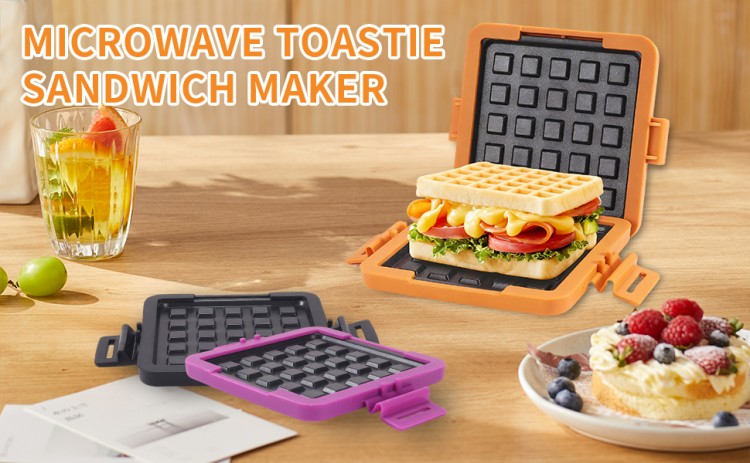
Can silicone go in the microwave?
It can, if the product is intended and labeled for microwave use. Health Canada advises consumers to use silicone bakeware according to the manufacturer's intended use and instructions. The USDA Food Safety and Inspection Service gives a similarly practical rule for microwave cookware: use utensils labeled for microwave use.
That wording matters. It does not say that every soft, rubbery kitchen item is automatically microwave safe. A silicone spatula, storage pouch, ice tray, baking mold, container lid and grill pan can use different formulations and constructions. Some are intended for heating. Others are intended only for storage or handling.
Our view at HeMaSe is simple: start with the finished product, not the material category. If you cannot find a microwave symbol, written instructions or a reliable product page, do not guess.
What does "microwave safe" actually mean?
In everyday use, microwave safe means the manufacturer intends the finished item for microwave heating under stated conditions. It does not mean the item stays cool. The FDA notes that containers can become hot from the food inside even when microwave energy passes through the container material.
It also does not mean one instruction covers every food and every appliance. Microwave wattage changes heating speed. High-fat and high-sugar foods can become very hot. A lid can trap steam. Grill or convection modes add another heat source that the product may not be designed to handle.
Material suitability
The silicone formulation and any colorants or additives must be appropriate for the intended food-contact conditions.
Product construction
Lids, coatings, inserts, handles, seals and closures have to be evaluated with the silicone body.
Conditions of use
Time, wattage, food load, ventilation and microwave mode determine how the product is actually exposed.
Food-contact language and microwave-use language answer related but different questions. The current US regulation at 21 CFR 177.2600 covers rubber articles intended for repeated food use and lists silicone polymers and elastomers within its framework, subject to the section's provisions. That is not a universal "FDA approved" badge for every silicone product. Evidence must match the specific formulation and intended conditions.
How does a cookware factory judge silicone microwave safety?
When a product reaches our desk, we do not squeeze it, smell it and declare it safe. Those checks can reveal an obvious problem, but they cannot establish intended use. We work through the product as a system.
First comes the recipe and material documentation. Then comes the geometry: wall thickness, corners, lid fit, vents and any conductive component. After that we look at the actual use case. A shallow sandwich press, a flexible food cover and a deep multi-pot do not experience heat or steam in the same way.
The problem we most often want to prevent is not dramatic melting. It is misuse at the edges of the specification: heating an empty coated pan, locking a lid without a steam path, selecting convection mode, extending the time because the first attempt was not crisp enough, or continuing to use a damaged surface.
That is why a trustworthy answer to "can you microwave silicone?" should include conditions. A one-word yes is easy to publish and easy to misunderstand.
What should you check before microwaving silicone?
| Check | What you want to find | If the answer is unclear |
|---|---|---|
| Microwave marking | A microwave-safe symbol or written permission from the manufacturer | Do not heat it until you confirm the intended use |
| Complete construction | No unknown trim, wire, decoration or insert; any special component is covered by the instructions | Do not treat "silicone outside" as proof for the whole item |
| Condition | No tears, sticky patches, severe discoloration, peeling coating or broken closure | Stop using it and contact the seller or manufacturer |
| Lid and vent | A stated way for steam to escape | Loosen or vent only if the product instructions allow it |
| Microwave mode | The mode named in the instructions, usually standard microwave mode | Avoid grill or convection mode unless specifically permitted |
| Time and wattage | A recipe or model-specific starting point | Begin with the shorter recommended time and add small increments |
| Food load | Food is present and does not overfill the container | Do not dry-heat cookware unless its instructions expressly call for it |
Are all silicone containers, molds and lids microwave safe?
No. Product format changes the decision, even when several items are described as food-grade silicone.
Silicone food containers
A silicone container can be microwave safe when it is labeled for that use. Check whether the lid must be removed, loosened or vented. A tightly sealed container can hold pressure as steam develops.
Silicone molds and bakeware
An oven-safe temperature claim does not automatically tell you how to use a mold in a microwave. Confirm that microwave use is included. Flexible sides also need physical support when the contents are hot and liquid.
Silicone lids and food covers
These products can help retain moisture and reduce splatter, but steam still needs a controlled path out. The USDA recommends loosening or venting microwave covers and leaving space so plastic wrap does not touch food. For a fitted silicone lid, follow its own venting directions.
Silicone utensils and accessories
A utensil may tolerate contact with hot food without being intended for prolonged microwave heating. Remove it unless the manufacturer specifically permits it to remain in the container.
Can silicone melt or get too hot in a microwave?
Silicone is valued for handling a broad range of kitchen temperatures, but it is not indestructible. Health Canada advises keeping silicone bakeware below 220 C (428 F) and following the manufacturer's instructions. A product may state a different lower working limit, and that lower limit controls.
The microwave does not need to heat the silicone directly for the cookware to become hot. The FDA explains that heat from food can transfer to a container. Oil, sugar, sauces and a conductive cooking plate can create hotter local conditions than a bowl of water. Handles may feel cooler than the cooking surface, but that is not a reason to touch the interior.
If a silicone item warps, develops a tacky surface, cracks or gives off a persistent abnormal odor during proper use, stop using it. Do not keep increasing the time to test whether the problem disappears.
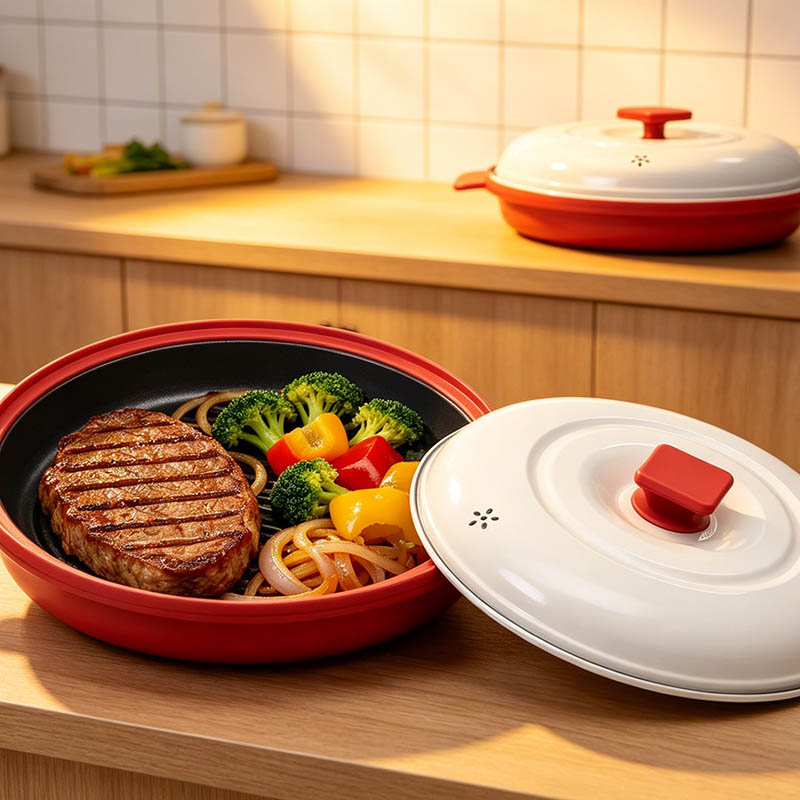
Can silicone cookware with a metal insert go in the microwave?
Only when that exact cookware is engineered and instructed for microwave use. For ordinary kitchenware, the safe default is not to put metal pans in a microwave. The FDA says metal generally reflects microwaves and may cause uneven cooking or appliance damage. The USDA also tells users to consult the appliance manual and follow specific instructions for any permitted metal use.
Purpose-built microwave grill cookware is a special case, not an exception you should improvise at home. Its conductive plate, edge geometry, surrounding materials and food load are designed as one system. A silicone shell around an unknown metal plate does not turn it into microwave cookware.
This distinction is important in our own range. The current HeMaSe Quick Cooking Microwave Toaster Grill Tray lists silicone, polymer and an aluminum plate. Its product page specifies an 800 W to 1200 W range, standard microwave mode only, food in the tray and a short first-use time. It explicitly excludes oven, induction, open-flame and microwave convection or grill modes.
The current Food Grade Microwave Multi Cook Grill Pot is another composite design. Its page lists silicone, an aluminized steel plate and a non-stick coating, with a 700 W to 1000 W microwave range. These instructions are model-specific. They should never be copied onto unrelated silicone cookware.
For a fuller explanation of purpose-built conductive pans, read our microwave grill pan guide.
How should you use silicone in a microwave safely?
A practical pre-heating routine
- Read the cookware instructions and the microwave manual.
- Confirm the microwave-safe marking and allowed cooking mode.
- Inspect the body, rim, lid, vent, coating and closures.
- Place the cookware level and add the intended food before heating.
- Vent or loosen the lid exactly as instructed.
- Use the shorter recommended time first and adjust for wattage.
- Turn or stir food when the recipe calls for it to reduce cold spots.
- Allow standing time where required, then open away from your face.
- Use heat protection and support flexible cookware from underneath.
Food safety still matters even when the container performs perfectly. Microwave heating can be uneven. USDA guidance recommends checking food in several places with a food thermometer when a safe internal temperature is required.
Do not treat a successful first use as permission to ignore the instructions later. A different recipe, a larger portion or a higher-wattage appliance changes the heat load.
When should silicone microwave cookware be replaced?
Normal staining is not the same as structural failure, but condition is part of safe use. Replace or seek model-specific advice when you find:
- cuts or tears that reach through the silicone wall;
- a rim or lid that no longer fits as designed;
- broken latches, blocked vents or loose components;
- peeling, blistering or deeply scratched cooking surfaces;
- warping that prevents stable placement;
- persistent tackiness or an unusual odor after proper washing.
On our locking grill tray, for example, the current product instructions tell users to check both the latches and the coating before use and to stop if either is damaged. That is more useful than a vague claim that silicone lasts forever. No cookware does.
Wash with the method stated for the model. For coated surfaces, soft sponges and non-metal utensils help avoid damage. Let hot cookware cool before exposing it to sudden temperature changes unless the instructions say otherwise.

What is the honest answer from the factory floor?
Silicone is a useful microwave cookware material because it can be flexible, easy to handle and compatible with carefully designed lids and shells. Still, "food grade" is not a complete operating instruction, and softness is not a safety test.
Our strongest recommendation is also the least exciting: buy a product intended for the job, keep its instructions and stay within them. For a plain silicone container, the microwave marking and lid directions are the starting point. For composite grill cookware, the named model, wattage range, microwave mode and food load become even more important.
That answer may be longer than "yes," but it is the answer we would want printed beside the product.
Sources checked
- Health Canada: The safe use of cookware and bakeware, page dated September 8, 2025.
- USDA FSIS: Cooking with Microwave Ovens, updated June 27, 2024.
- US FDA: Microwave Ovens, accessed August 24, 2026.
- 21 CFR 177.2600: Rubber articles intended for repeated use, current eCFR checked August 24, 2026.
Frequently asked questions
Is silicone microwave safe?
Silicone can be microwave safe when the finished product is intended and labeled for microwave use. Check the manufacturer's instructions, the complete construction, the condition of the item and any limits on time, wattage or microwave mode.
Can you microwave food in a silicone container?
Yes, if the container is marked for microwave use. Check whether its lid should be removed, loosened or vented, and do not exceed the product instructions.
Is food-grade silicone automatically microwave safe?
No. Food-contact suitability and microwave-use instructions are related but not identical. The final container, lid, inserts and intended heating conditions all need to be covered.
How long can silicone go in the microwave?
There is no universal time for all silicone products. Use the model's instructions and the recipe, account for microwave wattage and start with the shorter recommended time.
Can a silicone lid stay on in the microwave?
Only as directed for that lid. Steam needs a safe escape path, so a lid may need to be vented, loosened or positioned in a specific way.
Can silicone cookware with metal go in the microwave?
Only when the exact finished cookware is purpose-built and labeled for microwave use. Do not place ordinary metal inside silicone or assume a silicone covering makes an unknown metal item microwave safe.
Why does a silicone container get hot?
Hot food can transfer heat to the container. Use heat protection, support flexible cookware from below and take care when opening lids because steam can burn.
Should I stop using damaged silicone cookware?
Stop and check the manufacturer's guidance if you see tears, warping, a failed lid or latch, peeling coating, persistent tackiness or an unusual odor after proper cleaning.