

Yes, a microwave can cook steak. The difficult part is not whether the meat can become hot. It is getting an even internal temperature without drying some areas, while also producing the browned surface people expect from a pan-seared steak. Those are separate problems and they need separate checks.
You can cook steak in a microwave, but colour and grill marks cannot prove that it is safe. For whole beef steak, FoodSafety.gov lists a safe minimum internal temperature of 145°F (63°C), followed by a 3-minute rest. Check the thickest area with a food thermometer and check more than one location because microwave heating can be uneven. A microwave grill pan or conductive multi-pot may improve surface contact and browning, but it does not replace temperature verification.
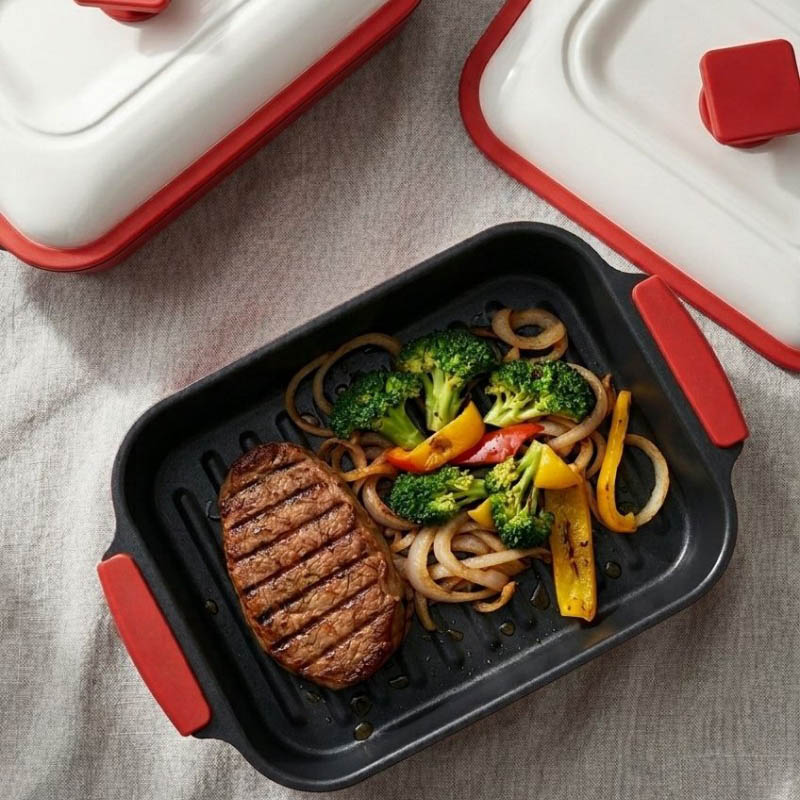
Is microwave steak really possible?
A microwave can transfer enough energy to cook beef. What it does poorly by itself is reproduce the dry, high-surface heat of a skillet or grill. That is why the answer depends on what you mean by "cook steak."
The coldest relevant point reaches the official minimum temperature and the required rest follows.
The center reaches the texture and juiciness the eater wants. Doneness is a quality preference, not visual proof of safety.
The exterior receives enough hot, dry contact to develop colour and a seared texture.
A plain microwave may achieve the first goal but struggle with the third. A conductive microwave grill multi-pot is designed to add a heated contact surface. Even then, the cookware does not make every steak thickness behave the same way.
What internal temperature makes microwave steak safe?
FoodSafety.gov lists whole beef steaks, roasts and chops at 145°F (63°C) with a 3-minute rest. Ground beef is a different category and has a higher listed minimum of 160°F (71°C). Do not apply the steak rule to burgers or ground-meat fillings.
Whole beef steak
Measure the thickest area and avoid touching bone, fat or the cooking plate.
63°C
Then rest 3 minutes
Rest time is part of the official safety instruction, not an optional serving tip.
The USDA explains that colour and firmness are unreliable safety indicators. A steak can look brown at the surface while a cold spot remains inside. Conversely, microwave-cooked meat can look less browned even after reaching a safe internal temperature. Use a thermometer, not the colour of the meat or the presence of grill lines.
What happens when steak cooks in a plain microwave?
Microwave energy interacts strongly with water in food. The energy does not cook meat neatly from the inside out. Penetration is limited, and heat continues moving by conduction from warmer zones to cooler ones. Shape, thickness, starting temperature, oven field pattern and position on the turntable all affect the result.
This is why one edge may tighten while a thicker section remains cooler. The USDA recommends checking microwave-cooked foods in several places and allowing standing time, during which temperature can continue to equalize.
The second limitation is the surface. Moisture keeps an exposed food surface relatively cool in a plain microwave. You can cook the meat, but a pan-seared crust is difficult without another source of surface heat.
Can a microwave grill pan improve steak browning?
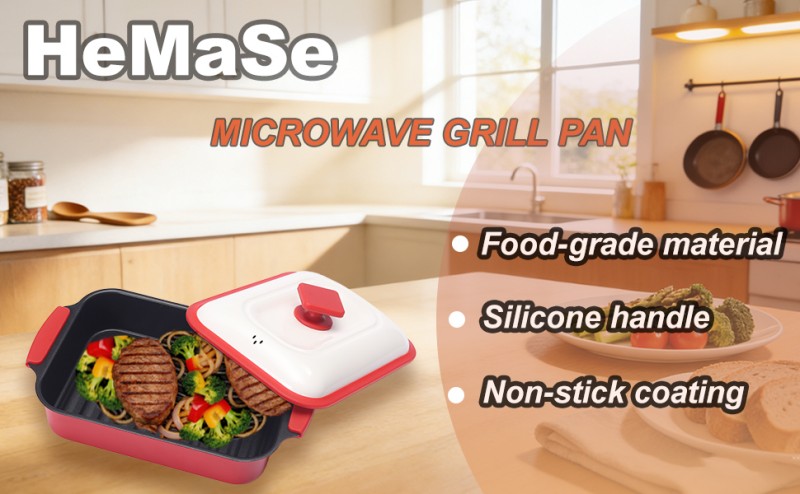
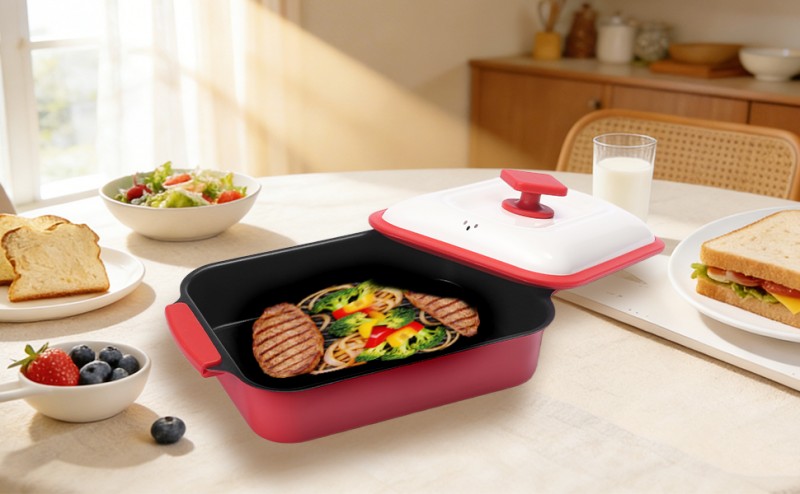
A microwave grill pan is built to add conductive heat where the steak touches the cooking surface. The current HeMaSe Microwave Safe Multi Grill Pot for Steak Cooking page shows a ridged coated base, deep sidewall, silicone-covered handles and a lid. That architecture targets contact heat, containment and a larger food load than a shallow sandwich tray.
Contact is still local. Raised ridges touch only part of the steak. They can create darker bands while the recessed areas receive less direct plate contact. That visual contrast is not a temperature map of the interior.
Which microwave cookware format fits steak?
| Format | Surface contact | Moisture behaviour | Best use | Main limit |
|---|---|---|---|---|
| Plain microwave-safe dish | No dedicated browning plate | Steam and juices remain around the meat | Heating or cooking where browning is not the priority | Pale, wet surface and uneven hot spots |
| Flat microwave grill tray | Strong contact on one or two faces depending on design | More exposed, with less containment | Thin, controlled portions that fit the plate | Limited capacity and possible splatter |
| Deep microwave grill pot | Ridged or coated base with surrounding sidewall | Lid can retain heat and steam | Steak with vegetables or a larger contained load | Steam may work against a dry crust |
| Microwave oven Grill Mode | Depends on rack and built-in grill element | More like appliance grilling | Ovens designed with this function | Not the same method as a microwave-mode grill pan |
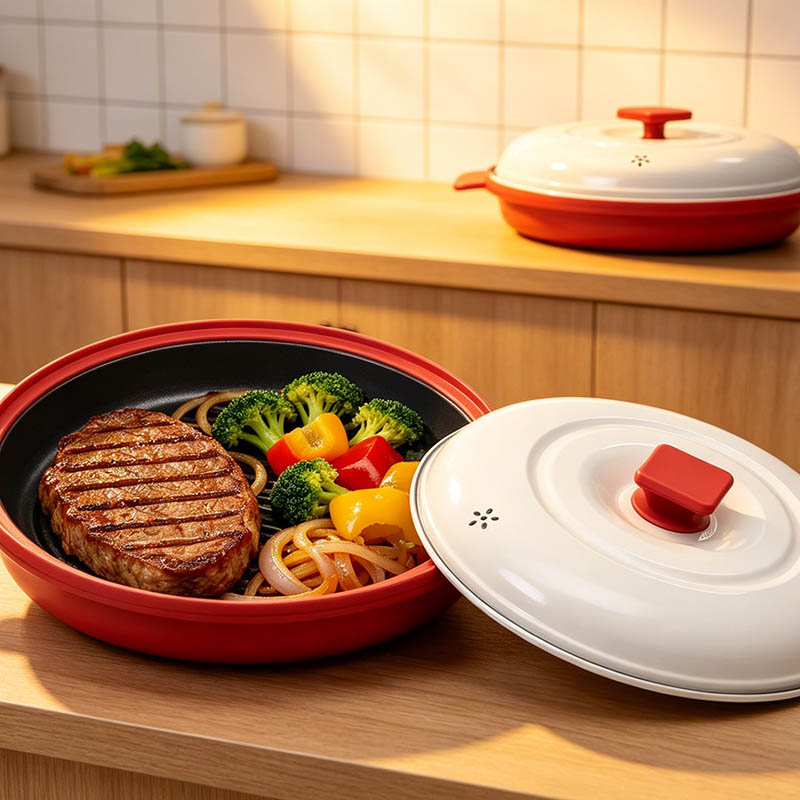
The Food Grade Microwave Multi Cook Grill Pot uses a deeper covered form, while the Healthy Low Oil Microwave Multi Cook Grill Pot is another current option in the same category. A shallow large-capacity microwave grill pan changes the balance between open surface and containment.
Choose from actual steak dimensions and the microwave cavity, not from a generic serving image. The pan must fit and rotate or sit as its instructions require. The steak should lie flat on the active surface without climbing the sidewall.
What is a safer framework for cooking steak in a microwave?
We do not publish one universal microwave steak time because that would hide the variables that matter. Use the exact cookware instructions and microwave manual, then control the process with a thermometer.
- Start with a fully thawed steak. A frozen center makes even cooking harder. Thaw safely in the refrigerator or follow official microwave-defrost guidance and cook immediately after microwave thawing.
- Choose an even piece. A steak with one very thick end and one thin tail will not heat uniformly. Keep the portion within the pan's flat contact area.
- Inspect the cookware. Do not use it if the coating, plate, lid, valve, handle or silicone support is damaged.
- Confirm the correct mode. A pan intended for microwave mode is not automatically approved for Grill Mode, convection, a conventional oven or an open flame.
- Follow the model-specific loading sequence. Do not invent a preheat routine or copy one from another microwave browning pan.
- Use staged checks. If the instructions call for turning, do it with heat-safe tools that will not scratch the coating.
- Measure several areas. Insert an appropriate thermometer into the thickest edible section and check another location if the shape is irregular.
- Reach the official minimum and rest. For whole beef steak, reach 145°F (63°C), then rest for 3 minutes.
Where should you check a microwave-cooked steak?
The thickest section is the starting point, but microwave heating can produce localized cold areas. Insert the probe from the side when the steak is thin enough that a top-down reading could touch the pan. Aim for the thermal center of the edible meat. Keep the tip away from bone, large pockets of fat and the hot cooking surface.
For an irregular steak, take more than one reading. If one location is below the minimum, continue according to the appliance and cookware guidance, then check again with a clean probe. Clean the thermometer between uses according to its instructions.
Do not judge safety from steam, grill marks, brown liquid or firmness. Those observations can help diagnose texture, but they are not substitutes for temperature measurement.
Why did the microwave steak turn grey, dry or uneven?
| Symptom | Likely cause | What to inspect | Next adjustment |
|---|---|---|---|
| Brown lines but cool center | Surface contact advanced faster than internal heating | Center temperature and steak thickness | Continue only by the model guidance and recheck temperature |
| Grey, wet surface | Plain microwave dish or heavy trapped steam | Cookware type, lid use and released liquid | Use an approved browning format if surface texture is the goal |
| Dry thin end | Uneven steak shape | Thickness from end to end | Choose a more uniform cut or manage thin areas per tested instructions |
| One face colours more | Unequal contact or no turning when the model requires it | How the steak sits on the ridges | Reposition only if the instructions permit |
| Juice pools around meat | Moisture has nowhere to escape or lid retains steam | Grooves, load size and lid instructions | Reduce crowding and follow the correct lid position |
| Coating or silicone is damaged | Sharp tools, abrasion or misuse | Scratches, peeling, distortion and fit | Stop using the pan and obtain replacement guidance |
Container shape is not trivial. Peer-reviewed work on microwave-heated meat patties found that container design affected temperature and moisture distribution. That study was not a steak test and does not prove performance for any HeMaSe model, but it supports a useful engineering point: lid and container geometry can change the heating pattern.
When is a microwave not the best method for steak?
Choose a skillet, grill or suitable conventional appliance when a hard sear is the main goal, when the steak is too large for flat contact, or when you need close control over a thick cut. A microwave grill pan is most credible as a compact cooking format with a defined food load, not as a claim that every steak can be reproduced exactly like outdoor grilling.
For product development, we would test the least forgiving condition, not just the best-looking serving photo. That means the thickest proposed steak, a cold start, the intended microwave range, the full vegetable load, the specified lid position and multiple temperature points. The test report should record both safety and sensory results.
Our broader microwave grill pan guide explains how conductive microwave cookware differs from ordinary metal pans and from a microwave oven's built-in grill function.
Frequently asked questions
Can you cook raw steak in a microwave?
Yes, a microwave can cook raw steak, but heating may be uneven. For whole beef steak, verify 145°F (63°C) in the thickest area and allow a 3-minute rest. Check more than one location when the shape is irregular.
How long does steak take in a microwave?
There is no reliable universal time. Steak thickness, mass, starting temperature, microwave output, pan design and lid position all change the result. Follow the exact cookware instructions and use a thermometer to confirm safety.
Can microwave steak turn brown?
A plain microwave usually produces limited browning because the moist surface stays relatively cool. A microwave-specific conductive grill pan can add contact heat and visible marks, but browning does not prove that the center is safe.
What temperature should microwave steak reach?
FoodSafety.gov lists whole beef steaks at a safe minimum internal temperature of 145°F (63°C), followed by a 3-minute rest. Ground beef has a different minimum of 160°F (71°C).
Is a microwave grill pan safe for steak?
Use only cookware specifically designed for microwave use, follow the exact model instructions and inspect it for damage. The pan does not replace safe raw-meat handling or temperature checks.
Are grill marks proof that steak is cooked?
No. Grill marks show where the surface contacted a hot ridge. They do not reveal the coldest internal temperature. Use a food thermometer in the thickest edible section.
HeMaSe · Ningbo Sai'an Intelligent Technology Co., Ltd.
Developing microwave cookware for a real steak use case?
Send our team the steak dimensions, full recipe load, intended microwave market, target lid format and acceptance criteria. We can discuss a current HeMaSe multi-pot or grill-pan format and define what the sample test still needs to verify.
Discuss your microwave grill-pan project