

Large Capacity Microwave Grill Pan with Non-Stick Coating is becoming an increasingly practical solution for consumers and foodservice businesses seeking faster, cleaner, and more versatile microwave cooking. HeMaSe, a China-based microwave cookware manufacturer specializing in OEM and wholesale solutions, develops this type of cookware with a multilayer structure designed to improve microwave heat conversion, browning performance, and everyday cooking convenience.
A conventional microwave is excellent for reheating food, but it often struggles to create the crisp texture and browned surface associated with traditional frying or baking. A properly engineered microwave grill pan can address this limitation by converting microwave energy into heat through an aluminized plate while distributing that heat across a non-stick cooking surface.
The Large Capacity Microwave Grill Pan with Non-Stick Coating combines food-grade silicone insulation, an aluminized steel plate, and a PTFE non-stick coating. This multilayer construction is designed for more consistent heating, easier food release, low-oil cooking, and simplified cleaning. It is suitable for applications ranging from frozen foods and breakfast dishes to meat, seafood, sandwiches, and selected microwave baking recipes.
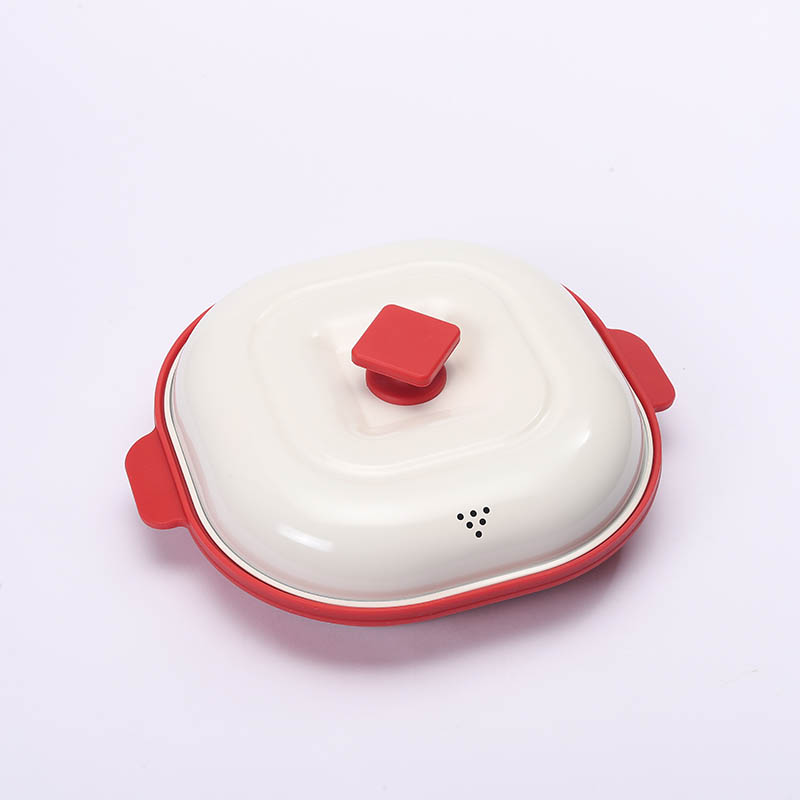
Table of Contents
- What Makes a Large Capacity Microwave Grill Pan Different?
- How Does the Multilayer Structure Improve Microwave Cooking?
- What Are the Main Advantages of Non-Stick Microwave Grill Cookware?
- What Are the Key Technical Specifications?
- Where Can a Microwave Grill Pan Be Used?
- How Does HeMaSe Control Product Quality?
- What Should Buyers Consider for OEM and Wholesale Orders?
- Frequently Asked Questions
- Why Choose a Large Capacity Microwave Grill Pan?
What Makes a Large Capacity Microwave Grill Pan Different?
Traditional microwave-safe cookware is generally designed to withstand microwave heating rather than actively improve the texture of food. Ceramic and plastic containers, for example, can heat food efficiently but may not provide the concentrated surface heat required for browning and crisping.
A Large Capacity Microwave Grill Pan with Non-Stick Coating takes a different approach. Its internal construction incorporates an aluminized plate that interacts with microwave energy and converts it into heat. The generated heat is then transferred through the cooking surface, helping food achieve a more appealing browned or crisp texture.
This design can be especially valuable for users who want to prepare food quickly without transferring it between a microwave and a conventional frying pan. The product is intended for standard household microwave ovens within the recommended power range, with the referenced HeMaSe model designed for approximately 700W–1200W microwave systems.
Its larger effective cooking area also makes the concept more practical for preparing multiple portions or larger individual servings, while the surrounding silicone structure supports easier handling.
How Does the Multilayer Structure Improve Microwave Cooking?
The performance of microwave grill cookware depends heavily on material selection and structural engineering. The HeMaSe design uses three primary functional layers, with each layer serving a different purpose.
| Layer | Primary Material | Main Function | Key Benefit |
|---|---|---|---|
| Outer Layer | Food-grade silicone | Thermal insulation and handling support | Helps reduce external heat transfer |
| Middle Layer | Aluminized steel plate | Microwave energy conversion and heat conduction | Supports browning and heat redistribution |
| Cooking Surface | PTFE non-stick coating | Food release and surface protection | Reduces sticking and simplifies cleaning |
The aluminized plate is particularly important because it acts as the heat-conversion component. A micro-textured surface can help distribute generated heat more consistently, reducing the localized heating that can occur with some conventional microwave cookware.
The silicone structure also contributes to usability. The referenced design uses an approximately 3.0 mm reinforced silicone wall, while the internal structure is designed to withstand high-temperature cooking conditions. Users should nevertheless follow the product instructions and use appropriate protection when handling hot cookware.
What Are the Main Advantages of Non-Stick Microwave Grill Cookware?
The combination of microwave energy conversion and a non-stick cooking surface creates several practical advantages.
- Improved browning: The heat-conversion plate helps create a hotter cooking surface than many basic microwave-safe containers.
- Less preparation time: The cookware is designed for direct microwave heating without conventional preheating.
- Low-oil cooking: The non-stick surface can support recipes requiring little or no added oil.
- Easy food release: PTFE coating helps reduce food adhesion during cooking.
- Simple cleaning: The smooth cooking surface can generally be cleaned with water and mild detergent and may be compatible with standard dishwasher cycles according to product instructions.
- Better handling: The silicone outer structure provides thermal insulation and creates a more comfortable grip around the cookware.
- Versatile applications: The pan can be used for a variety of microwave cooking and reheating tasks.
For consumers, these benefits can make microwave cooking more convenient. For retailers and importers, they can also create a differentiated cookware product that goes beyond basic reheating functionality.
What Are the Key Technical Specifications?
When selecting microwave cookware for household or commercial distribution, technical specifications should be evaluated alongside appearance and price. Material thickness, coating structure, dimensions, temperature resistance, and food-contact compliance can all influence long-term product performance.
| Specification | Reference Value |
|---|---|
| Effective Inner Area | 200 × 200 × 30 mm |
| Overall Dimensions Including Silicone Edge | 268 × 232 × 90 mm |
| Gross Weight | Approximately 711.6 g |
| Main Materials | Food-grade silicone + aluminized steel plate + PTFE coating |
| PTFE Coating Temperature Resistance | Up to 260°C / 500°F |
| Recommended Microwave Power | Approximately 700W–1200W |
| Food-Contact Compliance | FDA, LFGB, EU 10/2011 |
For OEM buyers, material configuration can also be customized according to the target market. HeMaSe offers a 0.6 mm aluminized sheet with a double-layer PTFE coating for economy-oriented home use, while a 0.8 mm aluminized sheet with a reinforced four-layer PTFE system is available for more demanding commercial or high-frequency applications.
These options allow importers and private-label brands to balance durability, performance, positioning, and target price.
Where Can a Microwave Grill Pan Be Used?
The versatility of this cookware is one of its strongest selling points. Instead of limiting the product to simple reheating, users can prepare foods that benefit from surface browning or crisping.
Frozen and Convenience Foods
Frozen chicken nuggets, fries, pizza, spring rolls, and similar semi-finished foods can benefit from direct microwave grilling. The heat-conversion structure is designed to help create a crispier surface than ordinary microwave reheating.
Breakfast Preparation
The pan can be used for foods such as bacon, eggs, and dumplings. This makes it attractive for busy households, office kitchens, dormitories, and convenience-oriented consumers.
Low-Oil Meals
Because the cooking surface is non-stick, users can reduce their dependence on cooking oil when preparing foods such as salmon, steak, or other suitable ingredients. Fat released naturally during cooking can also be directed toward grooves incorporated into certain pan designs.
Microwave Baking
Selected recipes such as cookies and egg tarts can benefit from bottom heat that helps develop a firmer or crispier base. Actual results depend on recipe composition, microwave power, food quantity, and cooking time.
How Does HeMaSe Control Product Quality?
For microwave cookware, quality control should extend beyond visual inspection. The performance of the coating, metal substrate, silicone structure, and finished assembly all influence the final user experience.
HeMaSe operates a dedicated microwave cookware production workshop and maintains an in-house PTFE coating sintering line. According to the product information, coating temperature control is maintained within approximately ±2°C during the relevant process.
The quality-control process includes several stages:
- Incoming material inspection: Aluminized sheet thickness is checked to maintain consistency.
- PTFE coating inspection: Coating thickness is monitored during production.
- Heat and peel testing: Sample products undergo microwave heating tests to check for coating blistering, peeling, or separation.
- Finished-product inspection: Products are visually and manually inspected for coating bubbles, particles, scratches, and other defects.
The company also identifies ISO9001:2022, BSCI, LFGB, FDA, and EU 10/2011-related compliance as part of its quality and food-contact assurance framework. Buyers should request current certificates and applicable test reports for their specific order and destination market before purchase.
What Should Buyers Consider for OEM and Wholesale Orders?
For retailers, distributors, importers, and private-label brands, selecting a microwave cookware supplier requires more than comparing unit prices. Product consistency, coating technology, documentation, packaging, customization, and production capacity can directly affect the success of a wholesale program.
HeMaSe provides OEM and wholesale services for this category. Silicone outer-edge colors can be customized using Pantone references, while additional coating options may be available for specific projects.
The referenced product information lists a minimum order quantity of 2,000 pieces and a typical production cycle of approximately 20–25 days. Sample development can include existing-sample evaluation, mold development where necessary, first-sample approval, and subsequent mass production.
For international buyers, packaging and documentation are also important. The product can be packaged through an OPP bag, color box, and outer carton structure, while shipping documentation may include commercial invoices, packing lists, applicable test reports, coating declarations, and certificates of origin where appropriate.
Before placing a bulk order, buyers should confirm:
- Target microwave power range and intended application.
- Pan dimensions and effective cooking area.
- Aluminized sheet thickness.
- PTFE coating structure and applicable food-contact requirements.
- Silicone material and temperature resistance.
- OEM color and packaging requirements.
- Required certifications and test reports for the destination market.
- MOQ, sampling procedure, production schedule, and shipping terms.
Frequently Asked Questions
Is a Large Capacity Microwave Grill Pan with Non-Stick Coating safe to use in a microwave?
Yes, this type of cookware is specifically engineered for microwave use when operated according to the manufacturer's instructions. The aluminized plate is enclosed within the product structure and designed to interact with microwave energy under specified conditions. Users should not operate the pan outside its intended application and should follow the instructions for their particular microwave and product.
Why does this microwave grill pan contain metal?
The aluminized plate is a functional part of the heat-conversion system. Unlike ordinary loose metal objects placed inside a microwave, this plate is integrated into cookware specifically engineered for microwave cooking. Correct use is essential, and additional metal objects should not be placed in the microwave during operation.
Is PTFE non-stick coating suitable for food-contact applications?
PTFE is widely used for non-stick cookware. When used within its recommended temperature range and intended application, it can provide a stable food-contact cooking surface. The referenced HeMaSe product information identifies FDA and EU 10/2011-related compliance for the coating system. Buyers should obtain current compliance documentation for their specific product configuration.
Can this pan be used on a gas stove or induction cooker?
No. This product is designed specifically for microwave ovens. It should not be used on induction cookers, gas stoves, electric hotplates, open flames, or other heating appliances unless a specific product has been independently designed and approved for those applications.
How can users extend the life of the non-stick coating?
Use silicone, nylon, or wooden utensils instead of sharp metal tools. Avoid overheating, follow recommended cooking instructions, and clean the surface with suitable detergents. If significant coating damage occurs, discontinue use and replace the cookware.
What is the MOQ for wholesale orders?
The referenced HeMaSe product information lists an MOQ of 2,000 pieces. Actual MOQ, customization requirements, sampling arrangements, and production schedules should be confirmed with the supplier before ordering.
Why Choose a Large Capacity Microwave Grill Pan?
A Large Capacity Microwave Grill Pan with Non-Stick Coating represents a practical evolution from basic microwave reheating toward faster, more versatile meal preparation. Its combination of an aluminized heat-conversion plate, PTFE non-stick cooking surface, and silicone insulation structure is designed to improve browning, heat distribution, food release, and handling convenience.
For consumers, the result is a convenient way to prepare crispy and low-oil foods without relying on multiple cooking appliances. For retailers, importers, and private-label brands, the product offers opportunities for differentiated microwave cookware programs backed by OEM customization and wholesale manufacturing capabilities.
If you are sourcing microwave cookware for retail, private-label, foodservice, or international distribution, HeMaSe can provide product customization, material options, packaging solutions, and wholesale support. To discuss specifications, samples, certifications, MOQ, or OEM requirements, contact us and request a tailored quotation for your market.