

Choose an open tray for one-sided browning, a clamshell press for two-sided sandwich contact, or a lidded pan for deeper portions. For a removable plate, check what you can reach when cleaning and how the plate seats when refitted. Confirm that both the pan and the microwave instructions permit the intended mode.
Which microwave grill pan design fits the food?
| Format | Food contact | What to check on the sample |
|---|---|---|
| Open grill tray | The base contacts one side, such as the underside of a pizza slice. | Check usable plate area and room for any handles inside the oven. |
| Clamshell press | Two plates hold the food between them. This layout suits a pressed sandwich. | Use the intended sandwich thickness to check how the upper plate sits and how the clips close. |
| Lidded grill pan | The base contacts the food. A separate lid leaves space above it for a deeper portion. | Check usable depth, headroom and any steam outlet against the model instructions. |
Start with the product's main use. A pizza slice needs enough plate area to lie flat. A filled sandwich needs enough room to close without forcing the latch. A covered meal needs usable depth below the lid. Those dimensions tell a buyer more than the widest point on the outside of the pan.
Removable vs. fixed grill plates
A removable grill plate is designed to lift out of its housing for cleaning. A fixed plate stays in the housing during routine care. On our 3-in-1 Microwave Toaster Grill Tray, the tray and silicone casing separate without tools. Our lidded grill pan illustrates a separate design feature. Its removable cover gives access from above. Ask the supplier to identify each part the user can remove during care.
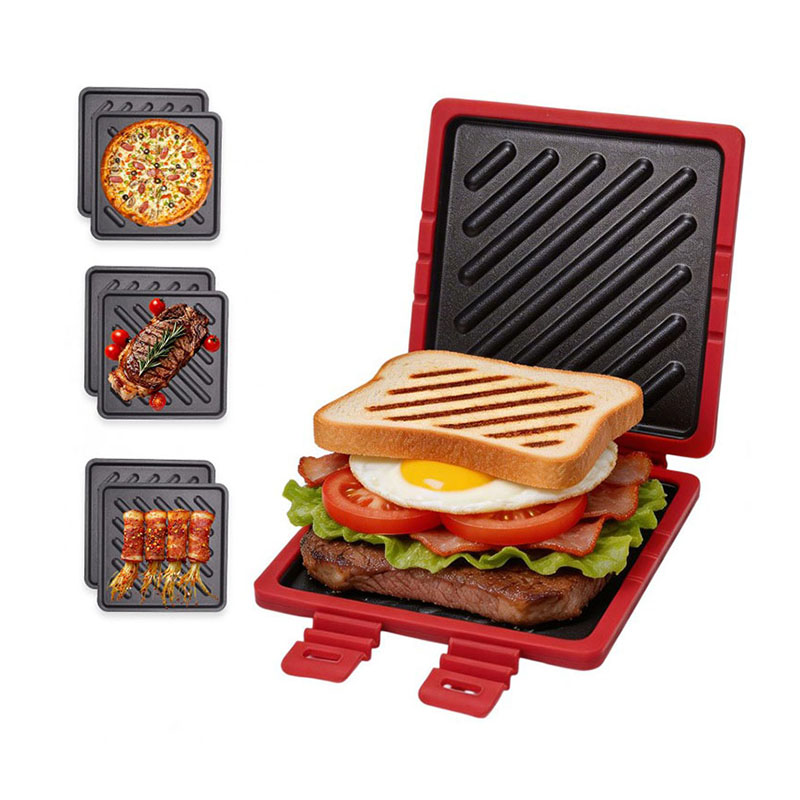
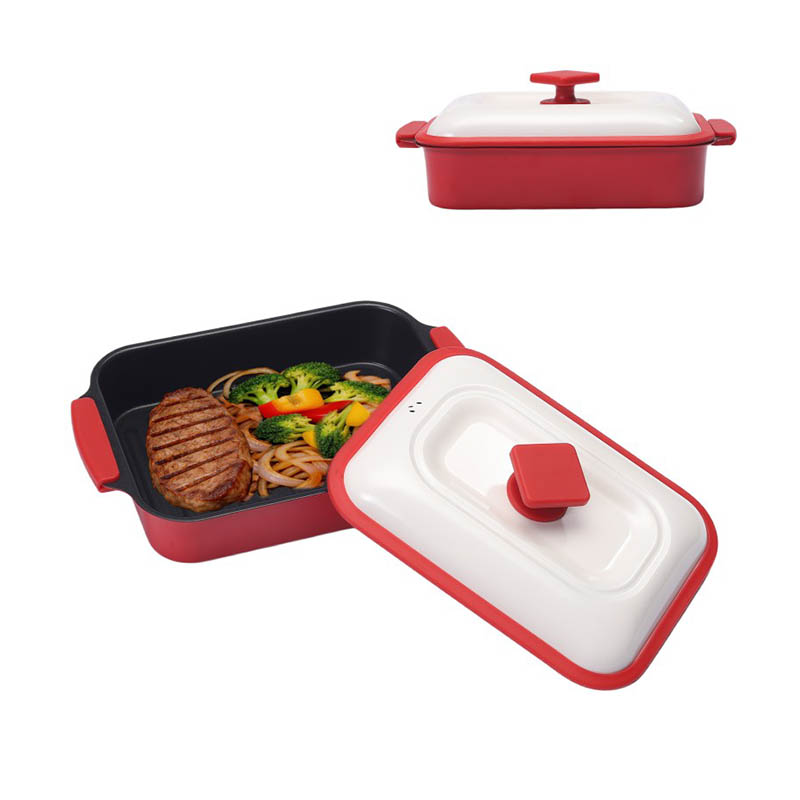
Removable assembly
Fixed assembly
Our advice is to inspect the plate edge before deciding. A detachable plate exposes the housing seat, where crumbs or sauce can collect. It also adds a step when the user puts the pan back together. With a fixed plate, the user can wipe the exposed surface without reseating it. The trade-off depends on the seam. A smooth, reachable edge may be easy to wipe, while a recessed corner can limit access.
For a clamshell, inspect where the plate meets the housing and where the clips engage. A plate can look seated from above while one corner is still raised. Check whether the orientation is obvious, the corners sit evenly and the clips close without extra force. These details matter when writing the care card and approval drawing.
Compare two grill pan samples side by side
Use the same food and fill level where both models allow it. Follow each model's care instructions and let both samples cool before handling or cleaning. Record the spot that was hard to reach, how the plate went back in, and how the pan closed. Use the same number of permitted cleaning and reassembly cycles if you repeat the check.
For example, a removable-plate entry might read “sauce behind left plate edge, accessible after lifting the plate.” A fixed-plate entry might read “left seam reachable with a soft sponge, residue visible at the back corner.” Record the location and what reached it. In the assembly field, note what guides the plate back into position, such as a shaped corner or visible orientation mark.
Sample comparison worksheet
Record your own observations for each sample. Compare the completed notes alongside the model instructions.
How a microwave grill pan browns food
In a pan designed for contact browning, a microwave-responsive part of the assembly heats the cooking surface. Heat passes from that surface to the food it touches. When the underside of a pizza slice lifts away from the plate or a press barely touches the center of a sandwich, the contact pattern changes. That is why plate shape, usable area and closure matter when the product brief calls for browning in a specific spot.
A stovetop pan receives heat from the burner. An electric sandwich press has its own heating element. A grill pan for microwave cooking depends on the oven and the way the particular pan is designed to receive heat. Use the pan's own instructions for food load, power and heating time. HeMaSe microwave grill pan operating guide.
Check the oven fit and permitted cooking mode
Read the pan and oven instructions together. Check the pan's full width and length with its handles or clips, then check height with the lid closed. In a turntable microwave, confirm that the loaded pan's footprint can rotate without striking the cavity walls. In an approved flatbed microwave, check the placement and clearances specified by the appliance manufacturer. Keep the turntable or other accessories in the configuration required by the oven manual.
Microwave mode, Grill Mode and convection use different heat sources. Our Quick Cooking Microwave Toaster Grill Tray is specified for microwave use and its instructions exclude Grill Mode and convection. Those instructions also call for food in the tray before heating. Check the preheat rule on each exact model.
The U.S. Food and Drug Administration advises using cookware made for microwave use and following the oven manufacturer's instructions. Treat any metal-containing cookware as model-specific and use it only when both sets of instructions permit the setup. The material name alone leaves the operating mode and cookware configuration unspecified. FDA guidance on microwave ovens.
What to put in a microwave grill pan brief
Write down the proposed model, the food it is meant to hold and the oven type first. Then list the approved cooking mode, dimensions with the lid or clips in place, the parts the user can remove, and the allowed care method for each part. Attach an assembly photo that shows how the plate and housing meet. For a clamshell, include a side view with the clips closed around the intended food thickness.
Use the same model description on the sample record, product listing and care instructions. If a design changes from fixed to removable, update the care instructions and the assembly image together. A buyer should be able to look at the parts in the box and tell immediately what comes apart, how it goes back together and which microwave settings apply.
Microwave grill pan terminology
Microwave grilling pan and microwave grill tray commonly describe cookware that sits inside a compatible microwave. Microwave grill cookware is the wider category and can include trays, presses and lidded pans. Product names such as crisper tray and sandwich maker describe a task or format. Check the parts diagram and operating instructions to determine the exact construction.
Frequently asked questions
What is the best grill pan for microwave cooking?
An open tray suits food that needs one side browned, a clamshell press suits sandwiches that need contact on both sides, and a lidded grill pan gives deeper portions more room. Choose a model whose instructions permit your microwave and cooking mode.
Can a metal grill pan go in a microwave?
Use microwave-specific cookware only when both the pan and oven instructions permit the exact setup. Ordinary metal pans should stay out of microwave mode. Follow the appliance manufacturer's directions for any accessories it supplies.
Does a removable lid mean the grill plate also comes out?
Check each part in the manufacturer's instructions. A lid may lift off while the cooking plate stays in the housing. A detachable plate should have its own removal and refitting directions.
Is a removable grill plate easier to clean?
A removable plate can give access to the housing beneath it. Compare the areas you can reach and the steps needed to put the pan back together. Follow the care instructions for each part.
Do I need to preheat a microwave grill pan?
Follow the instructions for the exact model. Some pans have a specified preheat cycle. Models that require food in the pan before heating should be loaded first.