

A buyer searching for a microwave grill pan with lid may be looking for two very different products: a deep pan with a removable cover, or a hinged tray that closes around food. Both have a top piece. They do not make the same promise. One creates room for a moist meal; the other is built around plate contact. Before choosing a shape, decide what the customer expects to cook and which surfaces must touch the food.
Choose a lidded microwave grill pan or multi-pot for deeper portions, sauced foods and a covered cooking space. Choose a clamshell microwave grill tray when the product promise depends on contact with both sides of a relatively flat food, such as a sandwich. A simple open plate is a third option when top-side contact or containment is not part of the brief. A lid alone does not guarantee crispness, and a closed clamshell is not the same as a deep, vented pot. Verify every food and cooking claim with the selected model, the permitted microwave mode and repeatable sample tests.
What does “microwave grill pan with lid” actually mean?
Product listings often place three architectures under the same search term. That is useful for discovery, but poor for specification. We separate them by the path between food and cookware, not by whether a catalog image shows something on top.
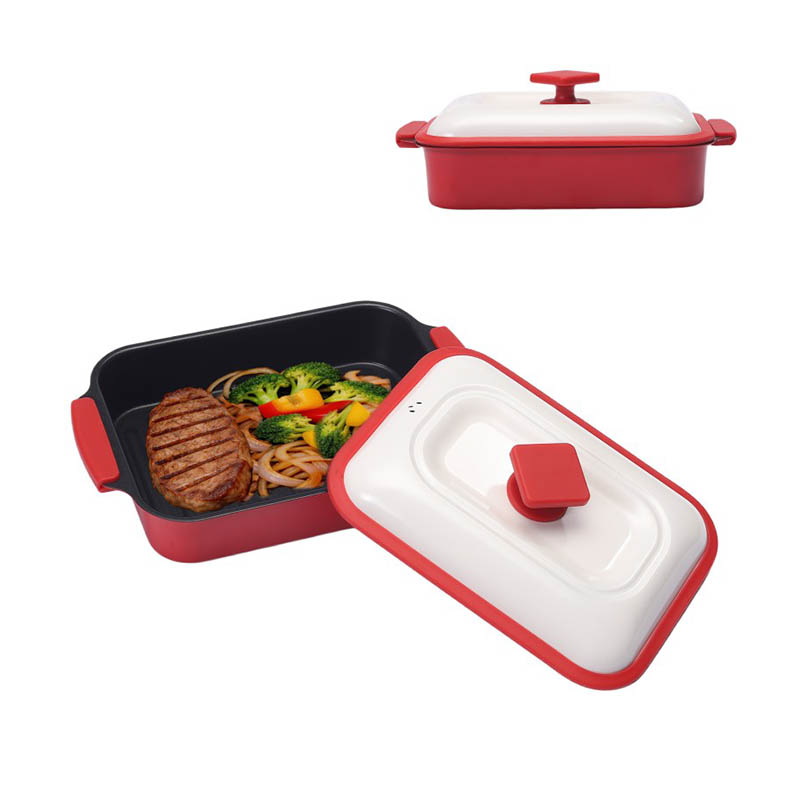
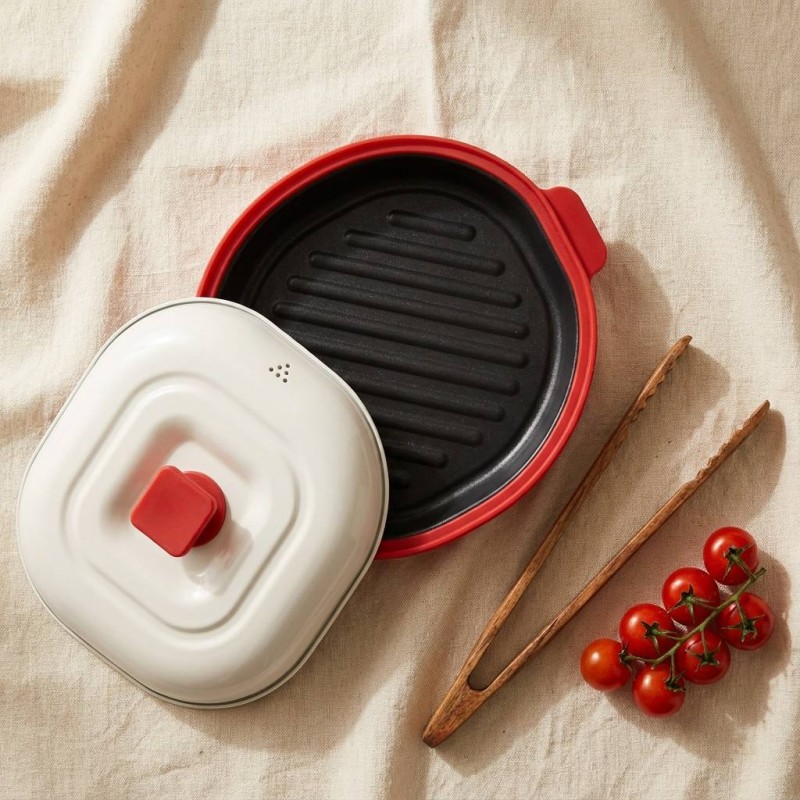
Deep pan with separate lid
The food sits in a deeper body. A removable lid covers the contents and may include a vent. It gives room for vegetables, mixed meals or foods with sauce, subject to the selected model's instructions.
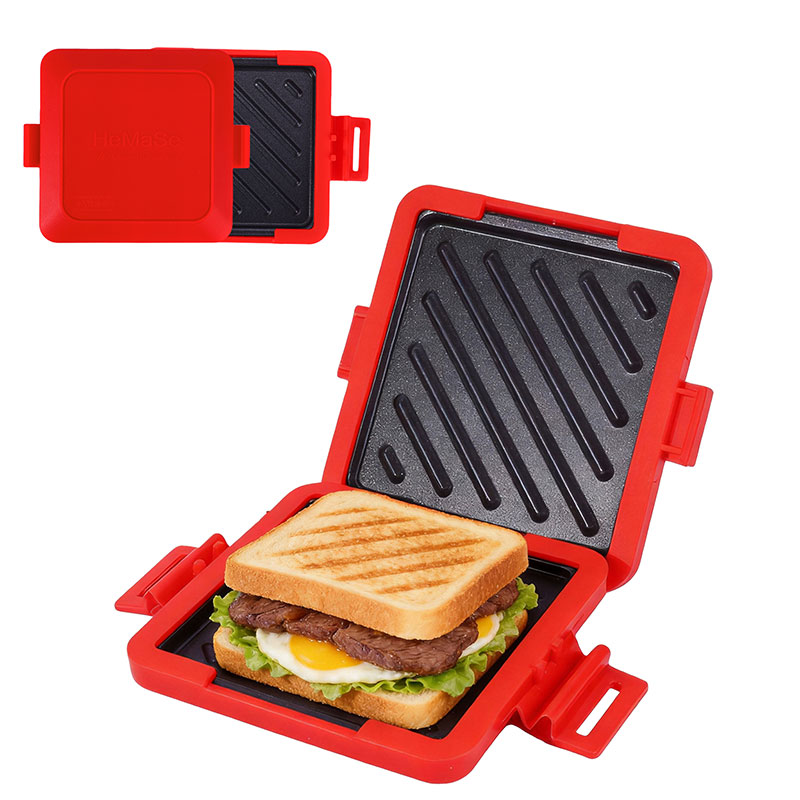
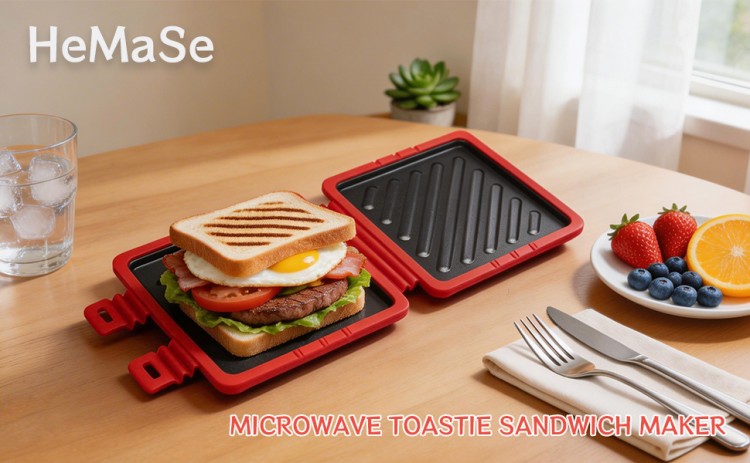
Closing clamshell tray
A top plate and bottom plate close around a flatter load. The closure position and food thickness determine how much contact the upper surface makes. It is not simply a pot with a lid.
Open crisper plate
A single exposed plate offers bottom contact without a built-in cover. It can be a useful comparator, but it cannot honestly carry a claim that requires a supplied lid or a heated upper plate.
HeMaSe's current catalog gives buyers real examples of the first two architectures in its Microwave Grill Multi-Pot and Microwave Toaster Grill Tray ranges. The names describe product families. They do not replace a model-specific manual or sample approval.
How do the three formats compare in a product brief?
| Decision point | Deep pan with lid | Closing clamshell tray | Open plate |
|---|---|---|---|
| Typical food shape | Deeper or mixed portion | Flatter, defined thickness | Food that can rest on one plate |
| Upper surface | Cover sits above the load; top contact is not assumed | Upper plate can contact the food if loaded and closed as designed | No supplied upper contact surface |
| Moisture and splatter | Covered space changes how steam and condensation are handled; vent design matters | Closure contains the load differently; fillings and steam need a clear path | More exposed to the cavity; food and microwave cover rules need review |
| Fit question | Body depth, lid height, knob and handles | Outside diagonal, hinge, latch and closed food gap | Plate footprint and handle sweep |
| Cleaning question | Body, lid, vent and any removable components | Two plates, hinge, grooves and closure zone | Plate surface and rim |
| Retail promise to test | Covered meal preparation and working capacity | Two-sided contact for a defined food format | Simple single-plate use |
These are design tendencies, not performance rankings. A shallow lidded model and a deep clamshell can blur the categories. The question is always what the selected sample actually does with the proposed food, load and operating mode.
Does a lid stop a microwave grill pan from browning food?
Not necessarily. A cover affects the cooking environment, but browning also depends on the accessory's construction, contact surface, food, load and permitted oven program. It is inaccurate to claim that every covered pan produces wet food. It is equally inaccurate to promise a crisp top merely because the pan has a lid.
There is a useful manufacturer example outside the HeMaSe range: Panasonic's Magic Pot guidance distinguishes between its lidded use for pan-searing or simmering, a steam-tray-and-lid setup for steaming, and pot-only use for a crisping-grill application. Those instructions belong to Panasonic's named accessory and ovens; they are not operating instructions for a HeMaSe pan. They show why “lid on or off” is a model-specific instruction rather than a universal SEO claim.
Condensation is another reason to be precise. A cover may hold moisture within the assembly; a vent may allow some steam to leave. Neither fact tells you how crisp a particular food will be. A vented cover is also not a pressure-cooking claim. The user instructions must explain any fill limit, lid position, vent handling and safe removal after heating.
Which HeMaSe models illustrate the choice?
Our live product pages show why a single “microwave grill pan” landing page cannot answer every buyer's format question. The Quick Cooking Microwave Toaster Grill Tray is presented as a closing tray with a silicone locking shell and four buckles. The Square Microwave Toaster Grill Tray shows a wave-pattern surface, handles and a buckle-style closure. For both, the buyer should ask about the loaded closure, plate contact and cleaning around the grooves, not merely whether a “lid” is included.
The Large-Capacity Microwave Grill Pan with Lid takes another route: a deeper body and a separate silicone cover. HeMaSe's Round Glass-Cover Microwave Grill Multi-Pot shows a deep round format with a transparent cover. Here the brief moves toward working fill, lid fit, steam release, handle clearance and packaging protection.
A third HeMaSe example, the 3-in-1 Microwave Toaster Grill Tray, has a detachable tray and silicone casing. That feature may matter more to a particular brand than a broad “with lid” label, because it changes the parts list, cleaning steps and packaging arrangement. Request the current drawing and instructions for any named model before adopting its page copy.
Which format fits the food your customer actually buys?
Start the range plan with a food job. “All-in-one cooking” sounds attractive on a carton but hides the tests that matter. A sandwich, a portion of vegetables and a sauced meal place different demands on the same assembly.
| Target task | First format to sample | What to observe | Claim to avoid until tested |
|---|---|---|---|
| Toasted sandwich or filled flatbread | Clamshell tray | Loaded closure, two-sided contact, filling escape and release from both plates | “Works with any sandwich thickness” |
| Pizza slice or flat leftover | Contact tray or open plate, depending on the intended top surface | Base texture, topping condition, portion fit and cleanup | “Restores oven-fresh texture” |
| Vegetables or mixed meal | Deep pan with lid | Working fill, steam path, evenness, lid removal and condensation | “No moisture loss” |
| Sauced portion | Deep covered pan | Spill control, heating endpoint, vent and handle cleanliness | “Leak-proof in every use” |
| Thicker solid portion | Shortlist only after checking the model's permitted use | Internal cooking endpoint, thickness limit, contact pattern and safe handling | “Cooks every protein safely” |
The matrix is a sampling sequence, not a recipe. It does not establish a cook time or safe internal temperature. Follow the selected product manual and applicable food-safety guidance for the actual food and market. If the target use includes raw meat, validate doneness with an appropriate thermometer and food-specific guidance rather than appearance alone. The USDA's microwave-cooking guidance explains why: microwave cooking can leave cold spots, so food should be checked in several places.
What changes in the engineering brief?
For a closing tray
- Specify the food-contact area on both plates, not just the outside footprint.
- Check closure with the intended load. A latch that closes when empty may not close correctly around a filled sandwich.
- Review where melted fillings, crumbs and condensation can reach the hinge, grooves and buckle zone.
- Confirm the operating mode and any limits on empty heating in the selected model's instructions. HeMaSe's Quick Cooking tray page specifies microwave mode only and warns against extended empty heating; do not generalize that instruction to a different model without checking its manual.
For a deep pan with lid
- Separate brimful capacity from the approved working fill. The first is a geometric volume; the second is a use limit.
- Check assembled height, lid knob, handle span and movement inside the target microwave.
- Define the vent and lid position for the actual food. A covered pan should never be presented as a pressure vessel without specific evidence and instructions.
- Plan for washing and packaging the separate lid. A glass cover, where offered, also needs protection appropriate to the chosen retail pack.
The practical trade-off is not “simple versus advanced.” It is where the product places its complexity. A clamshell spends it on controlled closure and plate contact. A lidded multi-pot spends it on depth, fill, cover, steam and handling. That framing makes a specification more useful than a feature-count contest.
How should a brand describe the format without overpromising?
Our position is to sell the task the construction can support, then make the result as specific as the test. “Closing tray for flat sandwiches” is clearer than “ultimate microwave cooking system.” “Deep pan with removable cover for covered meal preparation” tells a buyer more than “perfect grill pan.” Neither statement needs an invented temperature, miracle texture claim or vague “professional grade” label.
Keep three kinds of language separate on the carton and product page:
- Observed construction: separate lid, closing plates, side handles, ridged base or detachable casing, provided the selected model has them.
- Intended use: the foods and modes expressly supported by that model's instructions.
- Measured result: texture, cooking time, browning or comparison claims only after a documented test defines the food, load, appliance and endpoint.
This distinction protects the brand and helps shoppers choose. It also keeps an informational article useful: readers learn why the products differ before they reach the broader microwave grill pan guide or a specific product page.
How should an OEM buyer compare samples?
Do not compare one pan with a thin sandwich against another pan with a deep meal and declare a winner. Build the test around each proposed retail promise. For any head-to-head test, keep the food batch, portion mass, starting condition, oven, power setting and endpoint consistent. Record the exact accessory assembly and whether the lid or top plate is fitted as instructed.
We suggest logging the observations below rather than jumping to a single “crispness score”:
- Did the product fit and operate freely in the intended microwave models?
- Did the food make the expected contact without forcing a closure or exceeding a fill line?
- Where did moisture collect, and how was the lid or tray opened safely?
- Was the result consistent across repeat runs under the same conditions?
- What residue remained in grooves, vents, handles or detachable parts after cleaning?
- Does the final pack explain the correct model, mode, load and handling steps?
The output should be an approval record tied to a model and drawing revision. If the brand wants both a sandwich promise and a covered-meal promise, it may need two formats. One accessory can serve more than one task, but that is a result to demonstrate, not a line to assume in the brief.
Frequently asked questions
Is a microwave grill pan with a lid better than a clamshell tray?
Neither is better for every food. A separate-lid pan suits deeper or covered portions; a clamshell is designed around contact with both sides of a flatter load. Choose by the food task, permitted operating mode and tested result.
Will a lid make food soggy?
Not automatically. Moisture depends on the food, accessory construction, vent or cover position and cooking instructions. A covered pan may retain more condensation in some uses, but texture claims should be checked with the selected model and food.
Does a clamshell tray count as a microwave grill pan with a lid?
In a broad search listing, it may be described that way because it closes. In a product specification, call it a clamshell or closing tray: its upper plate may contact food, unlike a separate cover above a deep pan.
Can the same microwave grill pan cook sandwiches and sauced meals?
Only if the selected model's instructions and testing support both uses. A flat closing tray and a deep lidded pan solve different loading and moisture problems. Do not infer one use from the product family's name.
What should a private-label buyer ask HeMaSe for?
Send the target food, portion, market, microwave models, intended mode, desired format and retail claim. Request the current model drawing, instructions and samples, then agree on the test method, packaging and claim wording before approval.
Can I use grill or convection mode with these products?
Do not assume so. Operating modes are model-specific. HeMaSe's current Quick Cooking tray page specifies microwave mode only for that model. Check the selected product's manual and the oven manufacturer's instructions before making a mode claim.
HeMaSe | Ningbo Sai'an Intelligent Technology Co., Ltd.
Choose the Format Before You Request a Quote
Tell us which food your customer wants to cook, whether the brief calls for two-sided contact or a deeper covered space, and the microwave models and market you are targeting. We can use that brief to discuss a current toaster grill tray or grill multi-pot format and the samples needed to validate it.
Contact HeMaSe About a Model