

A flash inside the microwave is a reason to stop cooking, not to add another minute and watch more closely. A microwave-specific grill pan can contain a metal cooking plate, but a spark does not tell you whether the pan, a food wrapper, a nearby rack or the oven cavity caused it. First make the situation safe. Diagnose only after everything has cooled.
Stop the microwave immediately if a grill pan sparks. If there is fire or flame inside, leave the door closed, turn the oven off, and unplug it if safe to do so. If the fire does not go out, leave the area and call the fire department, following NFPA microwave-fire guidance. For a brief spark without fire, let the pan and oven cool before checking the exact cookware instructions, loose metal or foil, cavity clearance, food residue and visible damage. Do not restart an uncertain or damaged setup just to reproduce the flash.
Stop the cycle before you look for the cause
The first distinction is between a momentary arc and a fire. For either one, stop the oven. Do not lean close to the door to identify a flash while the cycle is still running.
Stop
Cancel the cycle immediately. Keep hands away from a hot pan and do not run the same setup again to check whether it repeats.
Keep the door closed
Turn the oven off and unplug it if you can do so safely. If the fire continues, leave the area and call the fire department.
Inspect, do not improvise
Read both manuals, remove unapproved items, and check the pan and cavity for visible damage. Seek service if the oven is damaged or the source remains unclear.
The USDA Food Safety and Inspection Service says to turn a microwave off immediately when arcing occurs because prolonged arcing can damage the oven or utensil. Its advice is general microwave guidance; it does not certify an individual grill pan. If smoke, flame or an electrical fault is involved, use the appliance manufacturer's emergency instructions and local emergency services.
Why does a purpose-made grill pan have metal if metal can spark?
The phrase "metal in a microwave" hides an important difference between an ordinary metal pan and an accessory designed for a named microwave use. The FDA's microwave guidance warns that metal pans generally should not be used and tells owners to follow the oven's instructions for acceptable cookware. Appliance-specific exceptions exist: JennAir's own instructions permit certain supplied or approved metal accessories under stated conditions, including keeping metal away from the cavity walls. Those JennAir permissions belong to its supported appliances, not to every microwave or to HeMaSe pans.
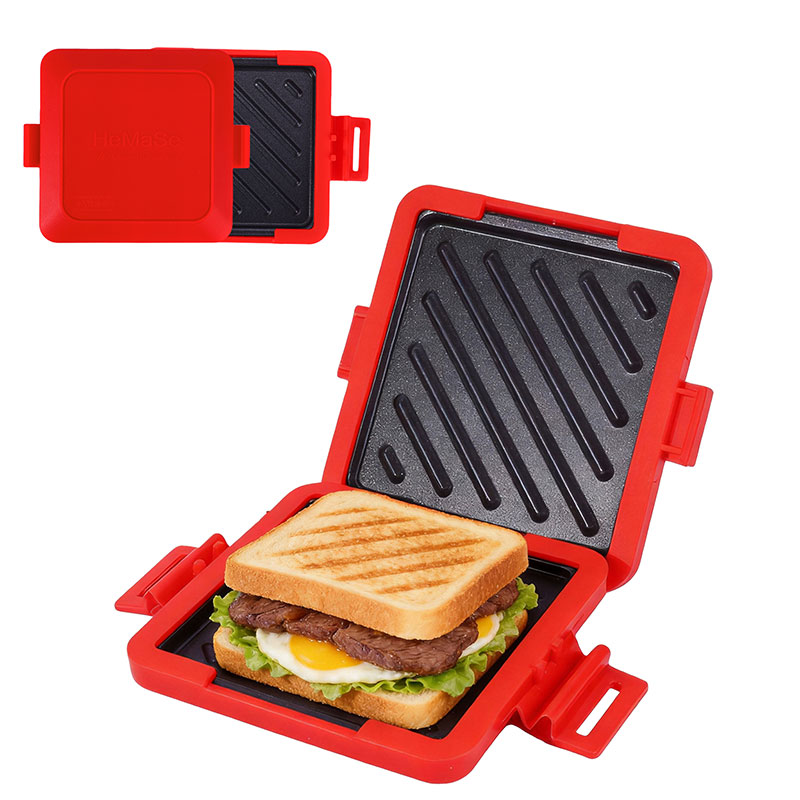
HeMaSe sells microwave toaster grill trays with coated cooking plates and silicone structures. Their metal-containing construction is one reason the exact product instructions matter. The name "microwave grill pan" is not permission to use an ordinary stovetop grill pan, and the presence of a silicone shell is not a guarantee against arcing in any oven. Fit, condition and operating mode still have to be checked.
Another source of confusion is the word "grill." A microwave grill pan is cookware; Grill Mode is an appliance setting with its own heating element. Our pan-versus-Grill-Mode explanation separates those two. A product approved for standard microwave mode is not automatically approved for Grill or Convection Mode.
What can make sparks appear when a grill pan is inside?
Do not assume the object closest to a flash is the cause. After the appliance is off and cool, use the table as a list of things to check, not as a remote diagnosis. LG's microwave arcing support names unapproved utensils, a wrongly fitted rack, food spills and cavity damage as possible sources. The exact response still depends on the oven model and what you actually find.
| What you notice after stopping | Possible issue to check | Safe next step |
|---|---|---|
| The tray sits close to, or touches, a cavity wall while turning | Insufficient clearance, a displaced turntable or an accessory too large for the oven | Do not use that pan in this oven until fit and rotation meet both manuals. Do not force the turntable. |
| A wrapper, twist tie, foil fragment, metal utensil or separate rack is present | An unapproved item may be arcing independently of the grill pan | Once cool, remove it and inspect for damage. Follow the oven maker's instructions before any further use. |
| Food is burnt onto the cavity or support area | Carbonized residue may contribute to sparking | Clean only by the oven maker's method after cooling. Stop if the cavity surface is burnt, blistered or otherwise damaged. |
| The coated plate is chipped, peeling or visibly altered; a latch is broken | The cookware may no longer match its approved condition | Do not use the affected pan. Record the exact model and contact the cookware maker. |
| Marks appear on the oven wall, door, rack support or waveguide-cover area | Possible appliance damage | Discontinue oven use and contact the appliance manufacturer or qualified service provider. Do not remove panels or attempt a home repair. |
| The selected setting was Grill, Convection or a combination program | The cookware may not be approved for that mode | Check both manuals. HeMaSe's Quick Cooking tray specifically excludes Grill and Convection Mode. |
A bright flash does not prove which row applies. One oven may have a food spill and an oversized pan at the same time. The point of a checklist is to avoid the easy but weak answer that "the metal pan did it" before the packaging, cavity and mode have been examined.
What do HeMaSe's published instructions say for one named tray?
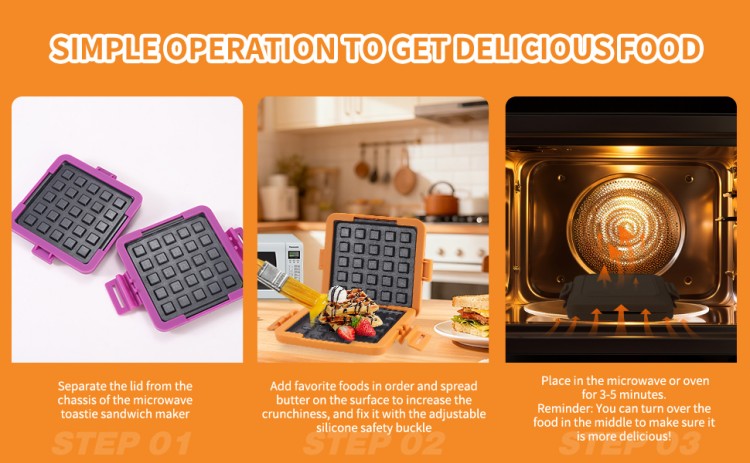
The current Quick Cooking Microwave Toaster Grill Tray page describes a coated plate inside a silicone locking shell with perimeter buckles. For that model, the page says to put food in the tray, avoid extended empty heating, and use standard microwave mode rather than Grill or Convection Mode. It also tells owners to inspect the latches and coating and stop use if either is damaged.
Those are useful checks for a reported incident involving that tray. They do not establish that its pan caused a flash, nor do they authorize a troubleshooting run with an empty tray. The model's printed instructions and the microwave oven manual should settle any difference between an online listing and the product actually in hand.
What should you check after the pan and oven cool?
Start with the evidence that can disappear if you clean everything first. Note which product and microwave were used, which mode was selected, what food and packaging were inside, and where the first flash appeared. Photograph visible marks if it is safe to do so. Then use the manuals to identify any item that did not belong in the cavity.
- Look at the load. Remove foil, twist ties, metallic trim, staples or other items the microwave manual excludes. Check whether the grill tray held food as its instructions require.
- Look at fit. Confirm that the pan was sitting as designed and that the turntable, if required, could move without the pan touching the cavity. Do not infer clearance from outside width alone; a handle or corner travels through a larger sweep.
- Look at the cookware. With the pan cool, inspect the food-contact coating, plate edge, silicone surround and any closure. Do not scrape a suspicious spot with metal to see what lies underneath.
- Look at the oven. Check for burnt-on food and visible cavity damage, including around any supplied rack support. Do not remove a waveguide cover or open the appliance housing. If the cavity is damaged, LG's guidance says to discontinue use and arrange repair service.
For cleaning a sound pan after normal use, our Quick Cooking product page calls for warm water and a soft sponge, not steel wool or a metal spatula. If the issue is a damaged coating rather than food residue, cleaning harder is not the solution.
When should the pan or microwave stay out of use?
Keep the pan out of use if its coating is peeling, its closure is damaged, its model cannot be identified, or its instructions do not permit the oven mode you used. Keep the microwave out of use if the cavity or door is visibly damaged, sparking continues, or you cannot identify a safe explanation. The FDA says not to operate a microwave whose door does not close firmly or is bent or otherwise damaged; LG directs owners to service for a damaged cavity.
We would not turn a brief incident into a universal "safe to retry" rule. If a removable twist tie is the only obvious issue and the oven and cookware show no damage, follow the oven manufacturer's model-specific instructions before use. If there is doubt, ask the oven maker or service provider. A cookware supplier cannot inspect the appliance from a product photo.
Do not attempt a home repair by sanding a scorched cavity, removing a protective cover, patching a food-contact coating, or bending a warped plate back into shape. Those actions can erase the evidence of what failed and create a different risk.
What details should you send with a HeMaSe pan question?
A useful report makes it possible to separate an appliance-fit issue from a cookware-condition question. Send the exact HeMaSe model or product link, photos of the cooled pan from both sides, the microwave's model and selected mode, a description of the food load and any packaging, whether the turntable was moving freely, and the location of visible marks. Include the manual or care label supplied with the pan if it differs from the website.
That is a suggested information set, not a claim that HeMaSe has already investigated a particular incident. We would rather review a specific pan and oven setup than make a blanket promise that any product with a silicone shell can never spark. If the microwave itself may be damaged, contact its manufacturer or qualified service provider as well.
Frequently asked questions
What should I do if a microwave grill pan sparks?
Stop the microwave immediately. If there is fire, leave the door closed, turn the oven off, unplug it if safe, and follow local emergency guidance if the fire does not go out. For a brief spark without fire, let everything cool and inspect the cookware, load and cavity before deciding whether either item can be used again.
Does a spark prove the grill pan is defective?
No. A loose twist tie, foil, food residue, insufficient cavity clearance, an unapproved rack or damage to the microwave can also be involved. Do not infer the cause from the flash alone. Stop use and check the exact product and oven instructions.
Can a microwave grill pan with a metal plate be used in a microwave?
Only when that specific cookware is designed and instructed for microwave use and the oven's instructions permit it. Ordinary metal pans are not interchangeable with a microwave-specific grill tray. Keep the pan clear of cavity walls and follow the approved mode for the exact model.
Can I run the microwave again to see whether it still sparks?
Do not repeat the same uncertain setup just to reproduce the flash. First let the oven and pan cool, check for unapproved items and visible damage, and follow the appliance manufacturer's troubleshooting instructions. If the cavity or pan is damaged, or the source is unclear, seek manufacturer or qualified service advice.
Can I use the HeMaSe Quick Cooking tray in Grill Mode?
No. The current Quick Cooking Microwave Toaster Grill Tray page says to use microwave mode and not the appliance's Grill or Convection Mode. Check the current instructions for the exact pan you own; another model's directions may differ.
What if I see a dark mark inside the microwave after a spark?
Do not assume it is only a washable stain. Let the oven cool and follow its manual to assess and clean ordinary food residue. If the cavity surface is burnt, blistered or otherwise damaged, discontinue use and contact the appliance manufacturer or qualified service provider.
HeMaSe | Ningbo Sai'an Intelligent Technology Co., Ltd.
Ask About the Exact Pan, Not a Generic "Microwave Grill"
Browse the HeMaSe toaster grill tray range to identify your model. If you need its current use instructions or want to report a cookware concern, send the model name and the cooled-product details described above. For suspected microwave damage, contact the appliance maker or qualified service provider.
Contact HeMaSe About a Model